AI Vision Boosts Warehouse Automation
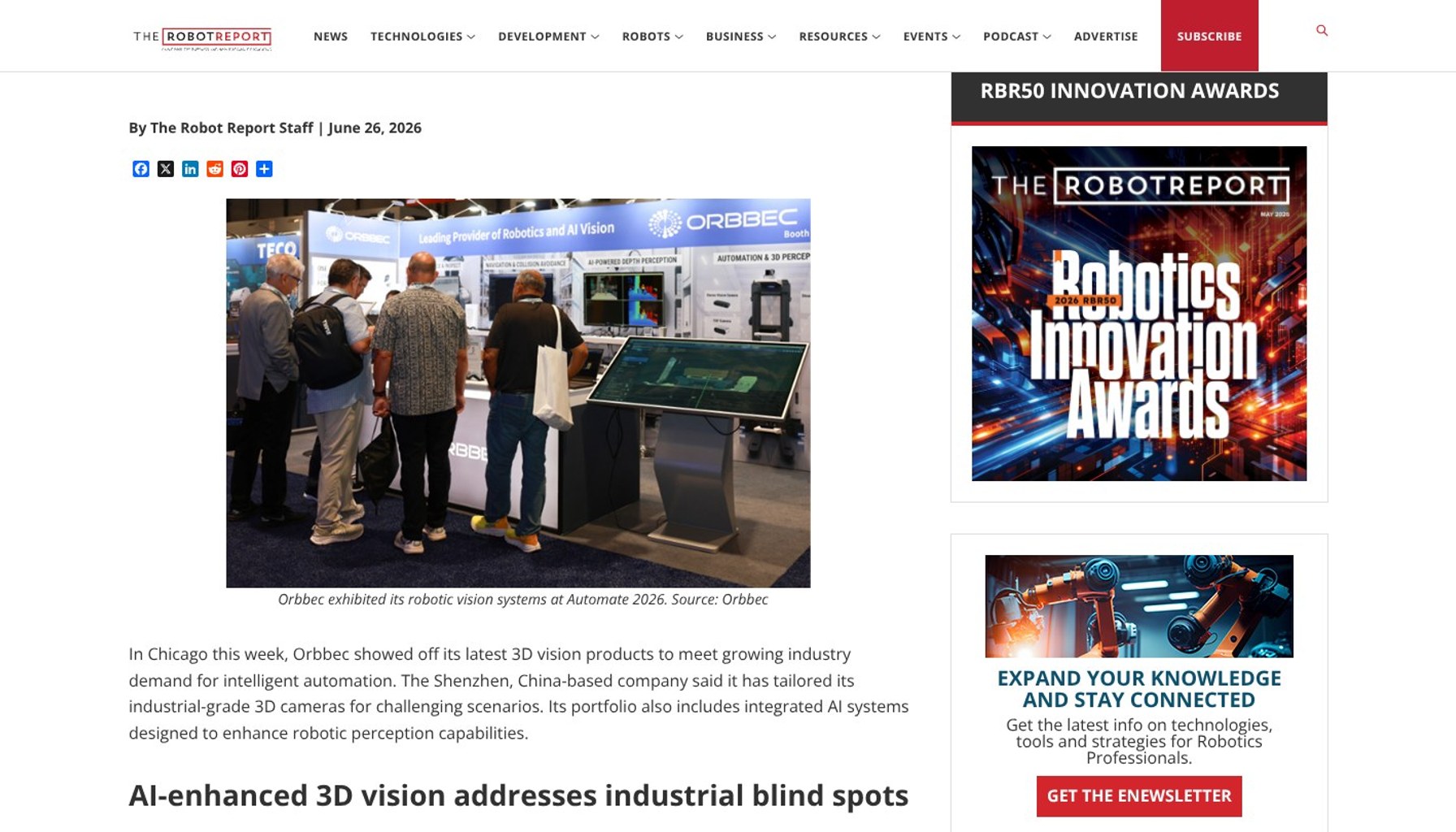
Image / The Robot Report
AI vision makes warehouse robots smarter and safer. At Automate 2026 in Chicago, Orbbec unveiled an edge AI driven upgrade to its industrial 3D cameras, designed to close sensing gaps in cluttered, reflective, or low texture environments. The company paired its LingBot-Depth for the Gemini 330 series with Robbyant’s in-house vision-language-action models, aiming to lift a robot’s spatial awareness and environmental understanding at the edge. Orbbec described the LingBot Enhanced Depth Filter as a way to feed high quality depth data into large models, a combination the partners say improves a robot’s manipulation capabilities and operational success rates. In practical terms, that means fewer missed grasps or misreads as robots navigate around glass, white walls, or shiny surfaces, an always-on challenge for industrial perception. Deployment data suggests tangible gains in perception reliability when depth data is fused with model-driven reasoning, a step that can translate into smoother pick and place cycles and fewer stops for re-sensing.
Across the aisle, Robust.AI is betting on a different path to steadier throughput. The company announced it has chosen Aptiv PLC’s PULSE sensor for its Gen 3 Carter mobile robot, a collaborative platform designed to augment human labor on the warehouse floor. By combining radar with vision through sensor fusion, Carter aims to keep critical perception reliable in the unpredictable real world, including dusty aisles, glare from metal surfaces, moisture changes and reflective packaging. Aptiv frames this as a safety-first approach that scales to broader deployments, arguing that the fusion of radar and vision supports the kind of safety-critical perception needed as robots share space with people and heavy equipment. The Gen 3 Carter is pitched as a software-defined solution that can handle order-fulfillment picking, point-to-point transport, and mobile sorting without laying down new infrastructure, which many operators will find appealing when balancing capex against ROI. In environments ranging from distribution centers to cold-storage floors, the combination promises robustness where single-sensor systems may falter.
The convergence of these developments highlights two distinct but compatible paths to automation ROI. Orbbec and Robbyant push the envelope on perception quality at the edge, enabling robots to reason about complex scenes with depth-aware context. Robust.AI and Aptiv target reliability and safety in dynamic environments, offering a pragmatic route to scale without heavy infrastructure changes. Both stories underscore a common truth for plant managers and CFOs: better perception is the fastest route to fewer exceptions, steadier cycle times, and higher utilization of the human workforce that still handles exception management, troubleshooting, and oversight.
Two realities worth watching. First, cycle times and throughput figures were not disclosed in the announcements, a reminder that ROI often hinges on enterprise-specific metrics such as line balance, piece-rate dynamics, and the mix of SKUs. Second, integration requirements matter. Orbbec’s approach relies on tight software compatibility between depth sensing data and large-model inference, implying a compute edge strategy and ongoing model updates. Carter’s path with PULSE emphasizes multi-sensor calibration, data fusion pipelines, and software-defined control that must be tuned to the specific clutter, lighting, and material profile of each facility. For facilities weighing these options, the decision often comes down to whether the priority is squeezing perception quality in edge cases (Orbbec-Robbyant) or maximizing reliability across highly variable environments with minimal infra changes (Robust.AI-Aptiv).
What to watch next. Look for real-world performance metrics as pilots scale: how cycle times compress with depth-aware perception in varied warehouse configurations versus how reduction in perception errors translates into fewer manual interventions. Expect more facilities to pursue a hybrid approach, combining edge-based perception improvements with multi-sensor fusion to deliver both accuracy and resilience in daily operations. The deployment data points to a future where perception quality, not just actuator speed, decides how quickly warehouses unlock the full potential of automation.
- Orbbec shows AI-powered vision systems at Automate 2026The Robot Report / Trade / Published JUN 26, 2026 / Accessed JUN 27, 2026
- Robust.AI chooses Aptiv PULSE sensor for Gen 3 Carter mobile robotThe Robot Report / Trade / Published JUN 25, 2026 / Accessed JUN 27, 2026