Seven-Axis Cobots Mount on AMRs Transform Warehouses
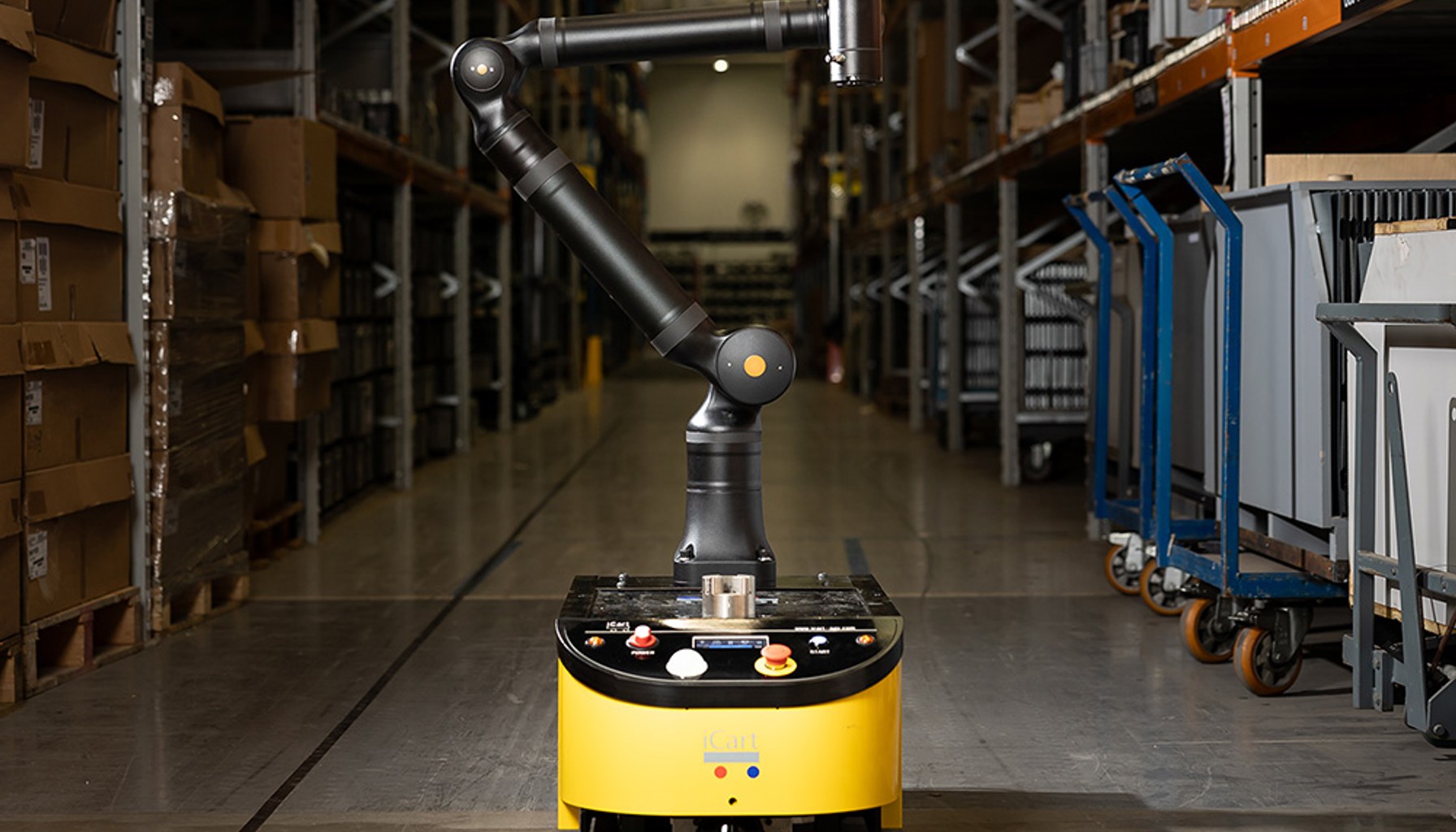
Image / The Robot Report
Seven-axis cobots on AMRs reach tight racks and lift heavier loads. That capability isn't magic; it's a concrete shift in how warehouses move tasks from humans to machines. The company reports that its cobots can reach difficult-to-access areas, handle heavier objects, and perform demanding tasks with accuracy, especially when mounted on autonomous mobile robots.
Warehouses have long relied on humans and fixed robotic stations for picking, palletizing, and machine tending. By pairing a seven-axis arm with an AMR, operators can load and offload materials, drive carts from station to station, and perform repetitive tasks without swapping between separate cobot and industrial-arm stations. The result is fewer manual touchpoints and streamlined workflows across the facility. Kassow notes the backdrive is integrated to facilitate positioning and programming, a feature that can shorten setup times and improve repeatability in busy environments.
From the engineering side, the appeal is practical: more reach and payload options without stapling together multiple robotic systems. The seven-axis arrangement expands maneuverability inside dense warehouses, letting on-board manipulation reach into narrow aisles, access under shelves, and perform assembly or screwing and labeling tasks that previously demanded a fixed robot arm at a bench or a dedicated station. The trend aligns with the broader shift Kassow describes in the automation of warehouse work, where autonomous mobile platforms and collaborative arms are converging to address labor shortages and rising productivity demands.
Industry observers point to a clear market signal in the numbers. The Robot Report notes that cobots mounted on AMRs are rising nearly tenfold from 2018 to 2025, underscoring growing adoption in picking, palletizing, and machine-tending roles. In this light, the seven-axis approach is less a novelty and more a practical response to real floor needs: greater reach, more precise handling, and a smaller hardware footprint than a suite of standalone robots. The engineering discipline behind these systems is becoming a tighter loop of design, testing, and field deployment, with backdrives and intuitive programming helping to shrink the gap between lab capability and on-floor performance.
Still, operators should expect constraints that come with adding complexity to an autonomous mobile platform. The arms Kassow markets are described as force- and power-limited, which means duty cycles and payloads must be managed to preserve speed and precision. Integrating a seven-axis arm onto an AMR introduces calibration and synchronization challenges between the arm and the mobile base, making robust sensing, control, and safety interlocks essential. A misalignment or a slip in the backdrive path can ripple into missed picks or dropped loads, so regular maintenance and periodic recalibration become part of the operating routine. Battery life and payload balance on the mobile platform are other practical limits to watch as facilities scale these solutions.
What to watch next, from a practitioner’s vantage point, is how these systems scale across fleets and facilities with different footprints and product mixes. Expect continued refinement of the interface between the AMR and the arm, tighter safety standards for human-robot interaction in busy warehouses, and more seven-axis variants designed to fit into existing rack layouts without expansive reconfiguration. In the near term, the most credible gains come from targeted deployments where the combination of reach, precision, and reduced touchpoints directly addresses labor bottlenecks in high-mix, high-volume operations.
Ultimately, this is an engineering system in action rather than a hype cycle. By packaging a seven-axis arm with an AMR, operators gain a single, mobile manipulation asset capable of loading, moving, and assembling along the facility floor, while keeping humans out of repetitive, dangerous, or ergonomically taxing tasks. The result is a more predictable process, a smaller number of handoffs, and a clearer path to scalable automation in warehouses.
- How compact cobot integration enhances autonomous mobile robot applicationsThe Robot Report / Trade / Published JUN 27, 2026 / Accessed JUN 27, 2026