Bear Robotics acquires Kinisi to fuel physical AI
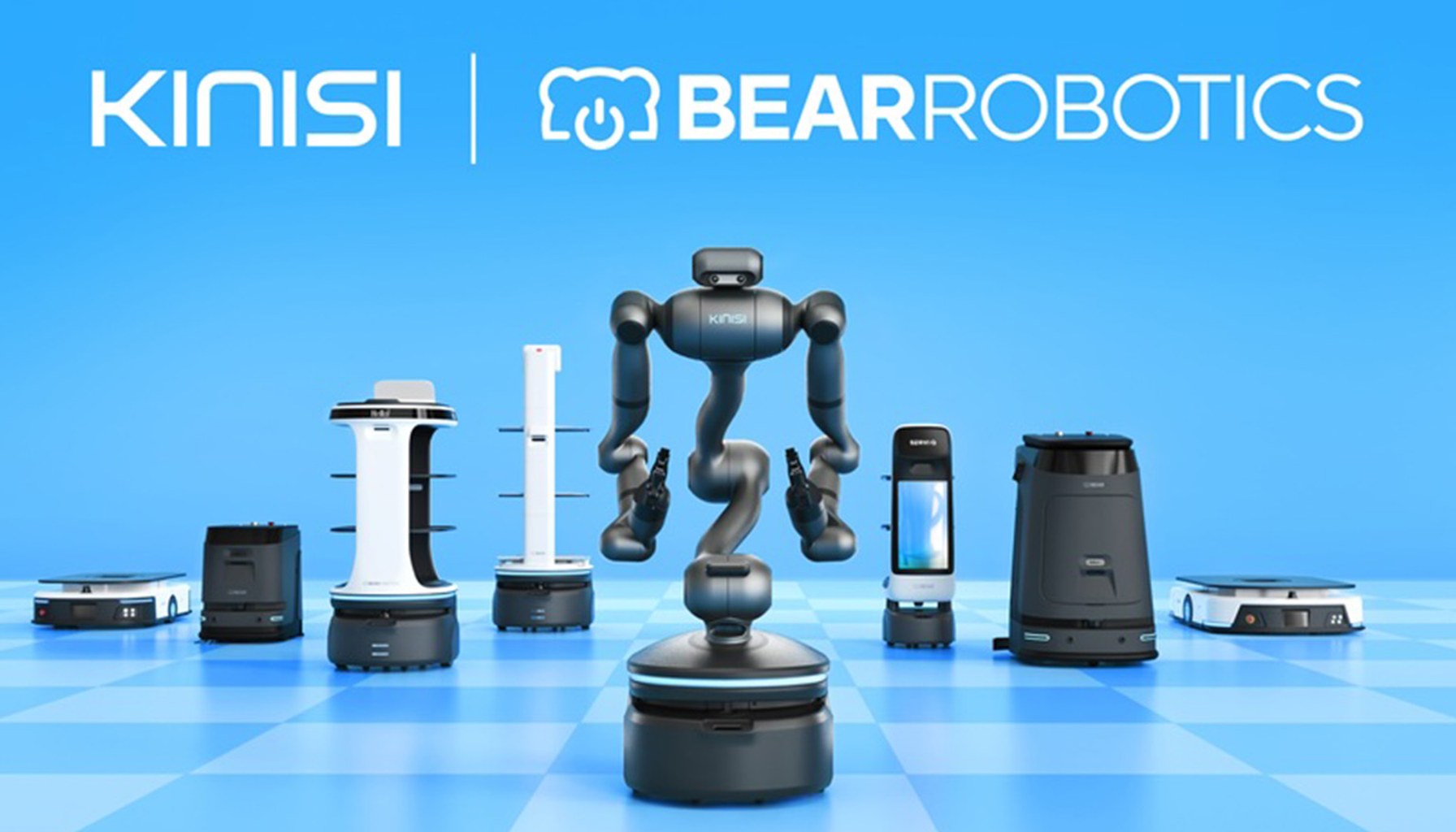
Image / The Robot Report
Bear Robotics buys Kinisi to power real-world manipulation. Bear announced a definitive agreement to acquire Kinisi Robotics, with closing expected in the coming days. On closing, Kinisi's KR1 humanoid robot, its Bristol-based engineering team, and its physical AI capabilities will be integrated into Bear Robotics, completing Bear's end-to-end physical AI robotics platform, the company reports.
Bear says its platform already runs thousands of robots in real enterprise settings, all controlled through a single cloud orchestration stack. The move to absorb Kinisi promises to extend that stack with a dedicated manipulation layer, a gap Bear has highlighted as the difference between moving robots around and having them actually perform work in front of humans and customers. The company notes that Kinisi has been building on Bear's production navigation stack since the two began collaborating, and that this stack powers Bear's commercial fleet. That ongoing technical relationship gave Bear an unusually clear view into the quality of Kinisi's engineering and the maturity of its KR1 manipulation platform, which Bear describes as the layer that lets robots move from navigation and delivery to actually handling the work.
John Ha, founder and CEO of Bear Robotics, framed the acquisition as the next chapter in Bear's mission to put robots to work in the real world. “Its manipulation AI is the layer that lets our robots move from navigating and delivering to actually handling the work in front of them,” he said, underscoring the strategic aim of linking navigation, perception, and manipulation under a single platform.
From a practitioner perspective, the deal embodies a hard shift in what it takes to deploy robots at scale. The industry has long debated whether a fleet can move from pilots to production without a robust manipulation capability. Kinisi’s KR1 expansion within Bear’s platform could provide the missing reliability needed for end users to entrust robots with tangible tasks, such as picking, sorting, or handling items in dynamic environments. But the integration also raises practical concerns that operators will watch closely.
First, the engineering challenge is non-trivial. Merging Kinisi's manipulation AI with Bear's navigation and cloud orchestration means aligning perception, motion planning, and control across a distributed fleet. The risk of mismatch between how KR1 grips and how the navigation stack plans paths in cluttered spaces could surface as a key failure mode if not carefully managed. Operators will want to see a clear continuity of performance across diverse environments, from busy restaurants to back-of-house warehouses.
Second, the business model hinges on scale and support. Bear already points to thousands of deployed robots, a foundation that could accelerate cross-sell opportunities for Kinisi technology. Yet scaling a single end-to-end platform raises service and safety considerations: updates, calibration, and safety certifications across a broad customer base must stay synchronized to avoid regression in real-world tasks.
Third, this move reflects a broader industry push toward end-to-end physical AI platforms. Rather than relying on separate navigation or manipulation modules, buyers increasingly demand an integrated stack with unified data, cloud orchestration, and hardware. Bear’s narrative positions Kinisi as a critical ingredient in a platform that can move from pilot to production across multiple use cases, potentially shortening time-to-value for enterprise customers.
In the near term, operators and investors will be watching for how smoothly the Kinisi integration rolls into Bear’s fleet, and whether the added manipulation intelligence translates into measurable gains in task completion, throughput, and safety in live deployments. If the fusion holds, Bear’s platform could serve as a more complete blueprint for real world automation, turning the promise of physical AI into repeatable, scalable results.
- Bear Robotics acquires Kinisi Robotics to boost its physical AI capabilitiesThe Robot Report / Trade / Published JUN 22, 2026 / Accessed JUN 22, 2026