Canada bets on automation to build more vehicles
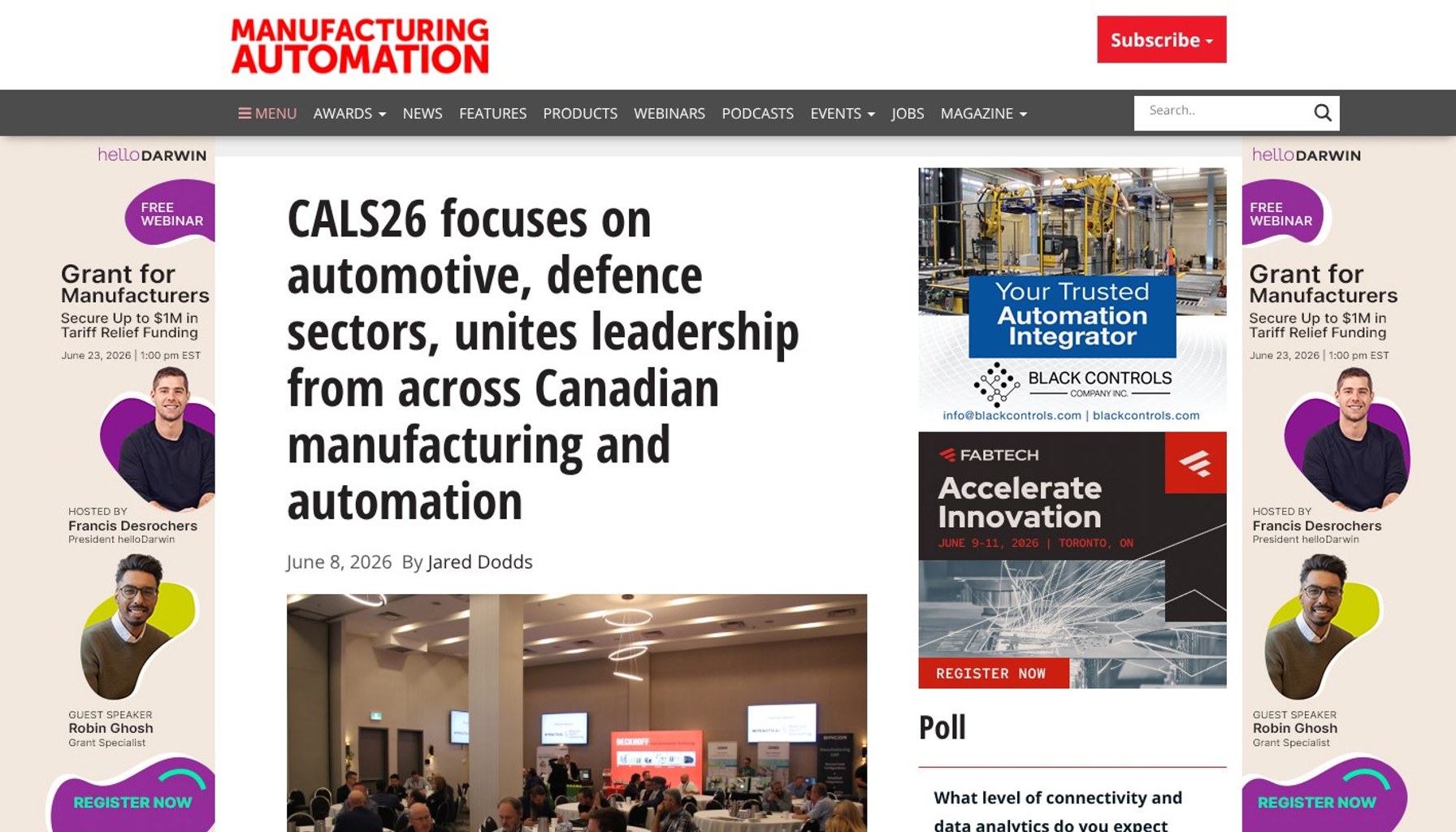
Canada is rewiring its factory mindset to build more vehicles.
The Canadian Automation Leadership Summit 2026 CALS26, staged on June 2, drew more than 70 leaders from Canada’s automotive and defense manufacturing communities to map a path toward higher productivity and faster technology adoption. The event kicked off with Brendan Sweeney, president and CEO of the Pacific Manufacturing Association of Canada, arguing that the country must focus on making more vehicles in Canada, not fewer. He framed this as a community and economic imperative, stressing the education required to spread the benefits of automotive manufacturing and the importance of maintaining free trade within North America for the industry’s health.
Deployment data shows the industry’s appetite for a practical, interoperable automation stack. The executive summary of a new Vendor Preference Survey highlighted at CALS26 digs into PLCs, sensors and vision systems, and robotics, covering both industrial robots and collaborative robots. The findings point to a preference for vendors who can deliver integrated solutions rather than isolated components, with reasoning rooted in the real world of line uptime, maintenance, and data capture. The case study reports on how end users weigh vendor choices, with implications for project timelines, integration risk, and long-term support.
The summit did not stop at theory. A panel on the dual use debate explored how rising defense spending could unlock new opportunities for manufacturing capacity, particularly in areas that overlap with automotive automation. Moderated by Jim Beretta, the discussion framed defense spending as a potential catalyst for accelerating technology adoption, while underscoring the need to align civilian production capabilities with national security goals. One panelist, Ilika Jovanovic, helped illuminate how the two sectors can share automation assets without compromising efficiency or resilience. The underlying message: automation is not a miracle cure, but a conduit for more capable, more flexible factories that can shift between civilian and defense contracts as market signals change.
For plant managers eyeing an automation project, several practitioner realities emerge from CALS26. First, lead with the operational metric. ROI hinges on cycle times and throughput, so planners should build end-to-end tests that capture how a new automation layer changes every step of the line, from input to finished product. Second, integration requirements matter. Vendors are increasingly judged by how well their PLCs, sensors, vision systems, and robotics play with existing control architectures and data platforms, not by performance in isolation. Third, when skilled trades are involved, automation should augment craft labor rather than replace it. Automation brings precision and visibility to linemen, inspectors, welders, and maintenance crews, but only if teams are engaged early and workflows are redesigned to leverage human expertise alongside machines. Finally, policy and funding signals matter. The prospect of higher defense spend is a lever for accelerating automation programs, yet success will depend on clear planning, supply chain resilience, and a realistic view of deployment cycles on factory floors.
Looking ahead, CALS26 underscored a pragmatic path: invest in modular, open automation architectures; align education and workforce development with long term production goals; and cultivate the cross sector collaboration needed to scale both automotive output and defense manufacturing in Canada. If leaders keep cycle times and throughput at the center of every decision, the country could see meaningful gains in productivity and domestic vehicle production over the next few years.
- CALS26 focuses on automotive, defence sectors, unites leadership from across Canadian manufacturing and automationAutomation Magazine / Independent source / Published JUN 08, 2026 / Accessed JUN 10, 2026