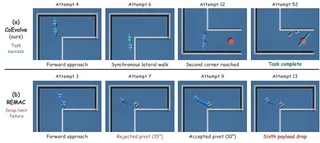
The simulation framework changes roles and movement plans while keeping each robot’s motor skills fixed.
CoEvolve is a research framework for two humanoid robots carrying one object through tight corridors. The authors, affiliated with Renmin University of China, Beijing XYZ Embodied AI, the Beijing Academy of Artificial Intelligence, and Peking University, report results from simulation—not a physical robot deployment.
The key split is between motor skills and coordination. Motor skills are the robot’s existing abilities, such as walking, turning, or moving sideways. CoEvolve leaves those capabilities and their policy weights unchanged. Instead, a multimodal model writes executable coordination using motion primitives, task goals, temporary roles, and bounded movement settings.
For example, a failed corner maneuver might prompt the system to change which robot supports the payload, revise the turning strategy, or adjust movement parameters. The simulator then restores the latest accepted checkpoint and tests the revised maneuver. Accepted outcomes become reusable experience for later decisions; rejected attempts do not count as successful examples.
In tests, two simulated Unitree G1 humanoids carried a freely supported 0.5-kilogram payload through constrained corridors. Across 15 base runs and three model families, CoEvolve completed eight tasks, with success reported for every family. The full task required placement, release, and both robots retreating upright within an 80-transaction budget.
The practical limit is clear: these were entirely simulated experiments using simulator measurements and route references. The authors still report problems with motion precision, payload contact stability, and physical recovery. Moving CoEvolve onto hardware would require onboard sensing, more accurate contact models, safe recovery behavior, and hardware-specific testing.