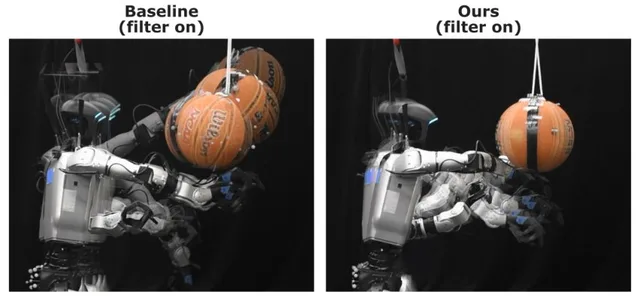
The proposed method lets a learned motion policy see constraints, remember corrections, and adjust before the filter must intervene.
A humanoid’s motion tracker turns a planned movement into commands for its joints. A runtime safety filter then checks those commands and changes them when they could violate a constraint, such as getting too close to an obstacle.
A paper on arXiv proposes CoFiT, or Constrained Filter-aware Tuning, to make those two systems cooperate. Instead of training the tracker as if the filter were absent, CoFiT fine-tunes it with the filter active.
The tracker receives a compact description of the nearest constraint, including which action directions could cause trouble and how quickly the robot is approaching it. It also receives recent constraint and correction history. Penalties discourage commands that force large filter corrections or leave constraints relaxed.
That changes the interaction from “tracker proposes, filter repairs” to “tracker anticipates, filter makes smaller corrections.” The filter still operates at runtime. It modifies the proposed command only as much as needed to satisfy its condition, according to the paper.
The authors evaluated CoFiT in simulation across two motion trackers, TWIST2 and SONIC. Compared with filter-only fine-tuning, they report 91% and 21% lower violation time, respectively, along with smaller corrections.
On a physical Unitree G1, the test involved a prescribed reaching motion near a basketball, with a virtual exclusion zone and the whole-body filter running at 50 hertz. In ten TWIST2 baseline trials, five required an emergency stop because of violent thrashing; CoFiT completed all ten without a stop. The paper reports an 83% reduction in violation time.
This remains a research result, not a product people can buy or a deployment guarantee. The authors tested local adjustments to fixed motions, not tasks requiring the robot to replan around fully blocking obstacles. They also note that model uncertainty and execution effects can still cause violations, so safety was measured empirically rather than guaranteed.