EDPB and European Commission set October stakeholder event on data protection and competition law guidance
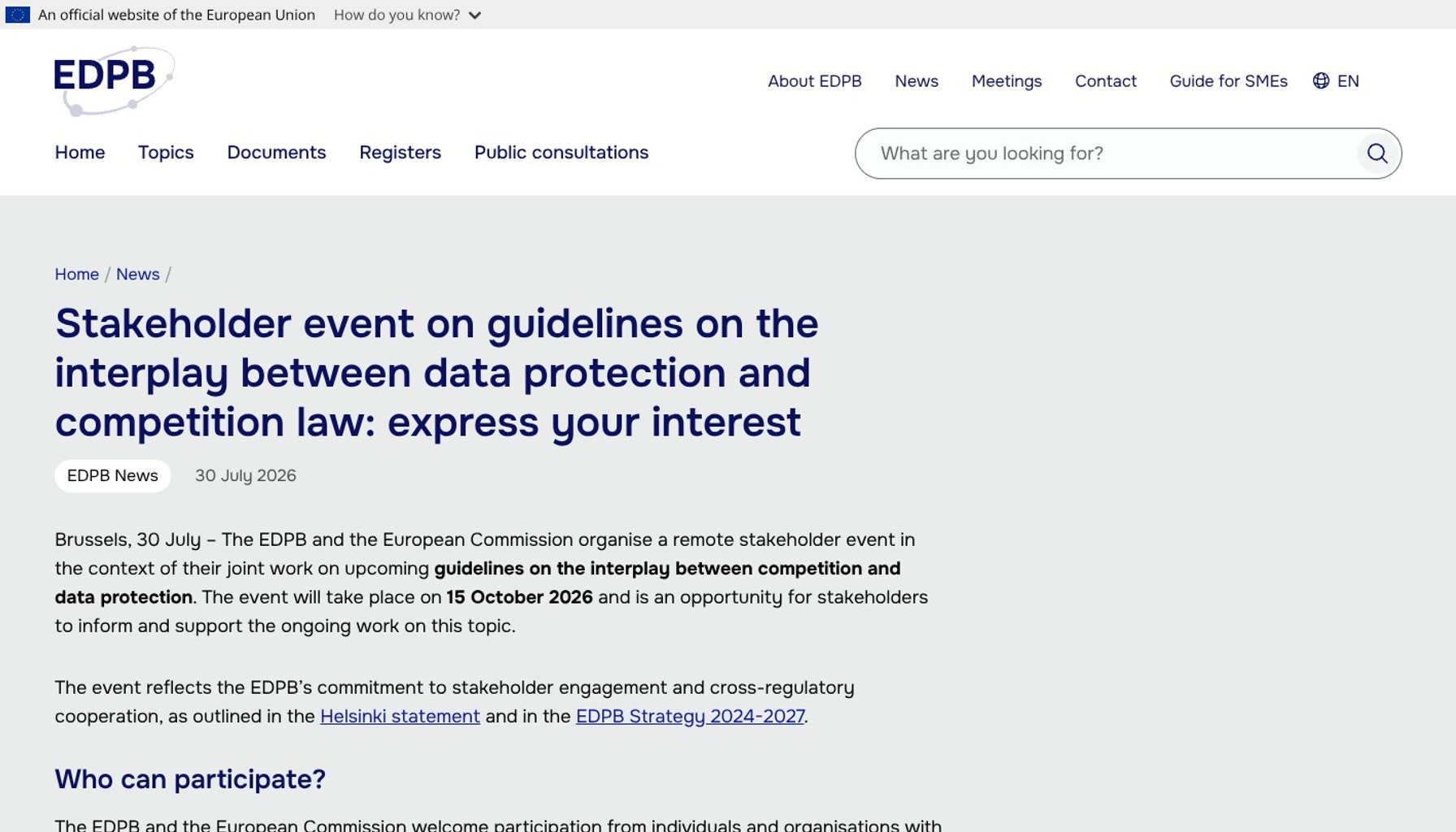
Image / edpb.europa.eu
The EU privacy watchdog and the European Commission are inviting experts to help shape upcoming guidance on how data protection rules and competition law interact, with interest submissions due by 28 August 2026.
Brussels opens a consultative step before new guidance
The European Data Protection Board and the European Commission will hold a remote stakeholder event on 15 October 2026 as part of their joint work on upcoming guidelines on the interplay between competition and data protection.
According to the EDPB, the session is meant to give stakeholders an opportunity to inform and support the work now underway. The invitation is not a final draft or a formal consultation on adopted text. It is an earlier-stage engagement step, aimed at gathering practical expertise before the guidance is finalized.
For technology companies, platform operators, adtech firms, data-driven businesses, and compliance teams, the topic matters because competition and privacy obligations often meet in the same products and business models. Decisions about data sharing, user consent, default settings, interoperability, market power, and personal data processing can have consequences under both regulatory regimes. The planned guidelines are expected to address that overlap.
Who the EU bodies want to hear from
The EDPB and the Commission said they welcome participation from individuals and organisations with relevant expertise in the topic of the event.
That wording is broad, but it clearly points to stakeholders who can speak to real-world effects and compliance challenges. In practice, that likely includes privacy specialists, competition lawyers, in-house counsel, policy teams, academics, industry associations, and companies whose services rely on large-scale data processing or platform design.
The event is being organized remotely, which should lower the barrier to participation for organizations across the EU and beyond. That matters for companies that may not have Brussels-based teams but still need to understand where the EU’s thinking is heading.
The EDPB said the event reflects its commitment to stakeholder engagement and cross-regulatory cooperation, citing the Helsinki statement and the EDPB Strategy 2024-2027. In plain terms, the board is signaling that it wants the privacy and competition regimes to be read together rather than in isolation.
Deadline: interest must be submitted by 28 August 2026
The immediate deadline is for expressions of interest. The call for interest is open until 28 August 2026.
That date is the key operational milestone for businesses and advisers who want a seat at the table. Anyone hoping to contribute should not wait until the October event, because the opportunity to register interest closes well before then.
The EDPB’s notice also says applicants who run into technical problems submitting the form should refresh the page or open it in a different browser. That suggests the sign-up process is web-based and time-sensitive, which is worth flagging for legal and policy teams coordinating submissions close to deadline.
What is at stake for tech and compliance teams
The overlap between data protection and competition law is not academic. It can shape how companies collect data, combine datasets, present choices to users, and compete in digital markets.
For technology leaders, guidance in this area can affect product design decisions long before a regulator opens an investigation. A privacy choice that looks sound in isolation may still raise competition concerns if it affects access, defaults, or market entry. Likewise, a pro-competition design feature may create privacy compliance issues if it changes the legal basis for processing or the way consent is obtained.
That is why the EDPB-Commission work deserves attention now. Guidance often becomes the reference point for enforcement discussions, internal risk assessments, and procurement or product review checklists. Even if the eventual guidelines do not create new legal obligations on their own, they can influence how enforcement authorities interpret existing rules.
The practical stakes are especially high for firms operating in digital advertising, app ecosystems, cloud services, marketplaces, social platforms, and other data-intensive sectors. These businesses are more likely to face questions about gatekeeping, data access, self-preferencing, bundling, consent flows, and the competitive effects of privacy choices.
Why the process matters before the text is final
The EDPB’s announcement shows that the guidance is still being developed. That means the October event is a chance to shape how the regulators frame the issue before language hardens into draft text.
For companies and trade groups, that is the moment to explain where rules conflict, where they are already manageable, and where additional clarity would reduce compliance risk. For example, stakeholders may want to point out how privacy safeguards can affect market access, or how competition interventions can change user expectations around data processing.
Because the effort is joint, the eventual guidance is likely to carry weight across both policy domains. That makes the current engagement phase more consequential than a routine informational meeting. Input now may help determine whether the final guidance is narrow and technical, or broad enough to affect how organizations structure their data and platform practices.
What organizations should do now
Organizations that operate in the EU data ecosystem should treat this as a calendar item and a policy monitoring issue.
First, review whether your business has relevant expertise or operational experience that would be useful to the EDPB and the Commission. Second, decide whether to submit an expression of interest before 28 August 2026. Third, identify internal owners across privacy, competition, product, and public policy so the organization can respond consistently if invited to participate.
Teams should also prepare a short list of concrete examples: where privacy requirements have affected competitive behavior, where competition rules have changed data governance, and where the two regimes have created uncertainty in product launches or market expansion. Regulators tend to respond better to specific operational evidence than general concerns.
For compliance leaders, the broader message is straightforward: the EU is actively working on how privacy and competition rules fit together, and it is asking stakeholders to help define that relationship. The window to engage is open now, but not for long.
- Stakeholder event on guidelines on the interplay between data protection and competition law: express your interestedpb.europa.eu / Primary / Published JUL 29, 2026 / Accessed JUL 30, 2026