Temple, Demco automation grant aims to turn AI into a shop-floor skill, not a buzzword
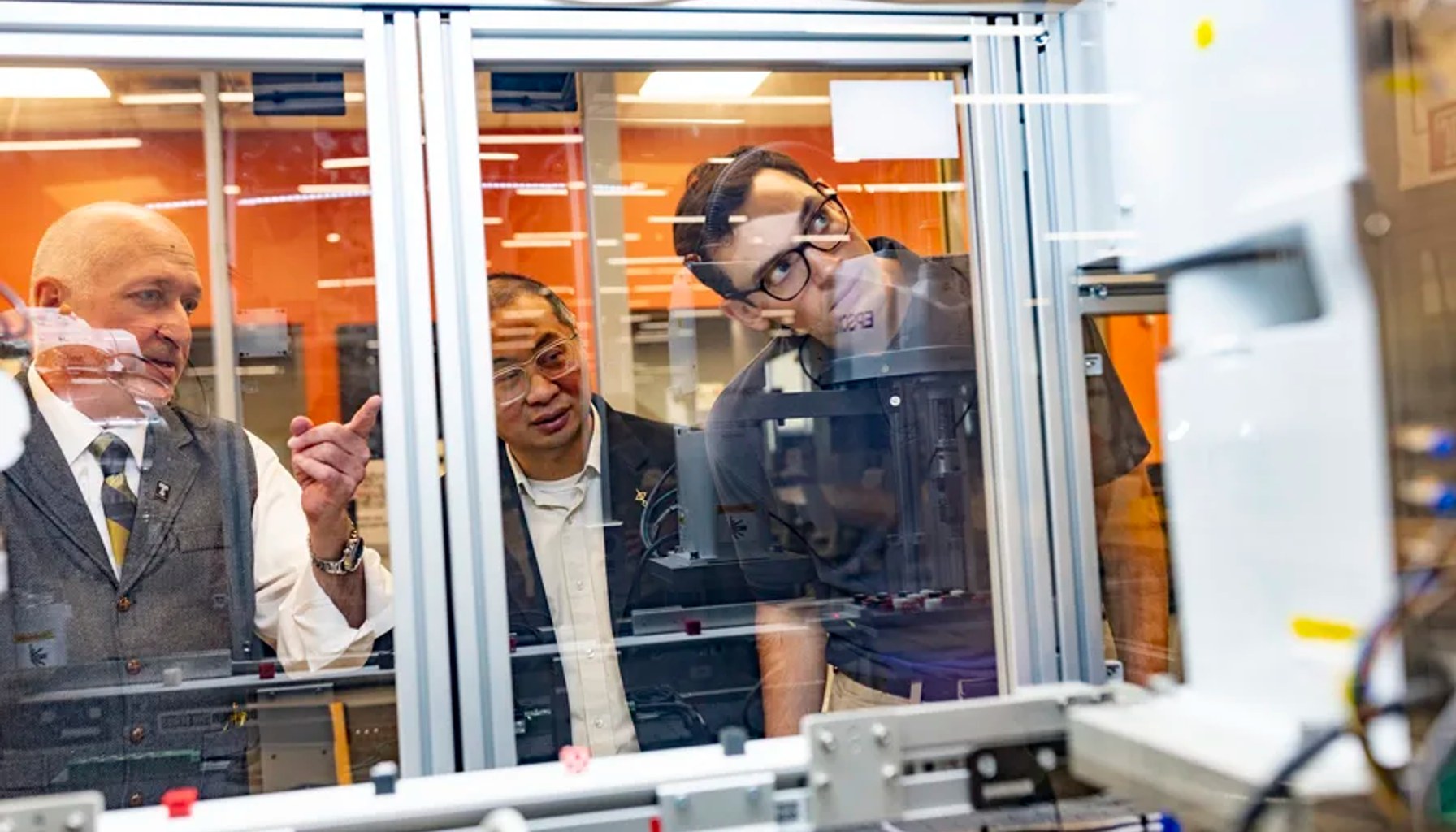
Image / assemblymag.com
Temple University and Demco Automation are building a manufacturer-facing training and development pipeline around AI, with a Pennsylvania grant, student-led robotic cell work, and a real customer problem as the test case.
A grant tied to a live manufacturing need
Philadelphia’s Temple University and systems integrator Demco Automation have received $69,530 from Pennsylvania’s Department of Community and Economic Development to explore how AI can help engineers design and build automated manufacturing systems. The funding comes through the state’s Manufacturing PA Innovation Program, which supports projects that pair Pennsylvania students with local manufacturers to develop new technologies and advance innovation.
The total initiative is larger than the state award alone. Demco’s contribution of equipment and staff mentorship hours pushes the company’s donation value to more than $94,000, bringing the overall initiative value to over $163,000.
For plant managers and operations leaders, that matters because this is not a general research grant with no obvious plant-floor output. Temple engineering students are being asked to use AI to streamline the design and production of automated assembly systems, then apply that work to a Pennsylvania manufacturer of consumer products. The stated goal is to design and build a robotic manufacturing cell tailored specifically to that business’s needs.
That makes the project closer to an automation deployment exercise than a theory seminar. The payoff will depend on whether the team can shorten engineering time, reduce customization friction, and deliver a cell that actually fits the customer’s throughput and labor constraints.
What the partnership is trying to prove
Stephen Maund, president and CEO of Demco Automation and a 1999 graduate of Temple’s College of Engineering, said AI and automation “really go hand-in-hand.” He said using AI in custom automation applications and rapidly deploying automation tailored specifically for a business or factory can be “a true competitive advantage.”
That framing is important. In manufacturing, automation rarely fails on the concept. It fails in the translation from concept to installed system: part variation, line constraints, controls integration, training, maintenance, and the hidden engineering hours that can overwhelm a supposedly simple ROI case. Demco’s role in the project suggests the company is trying to train students on exactly that gap.
Temple students will work directly with the Pennsylvania consumer-products manufacturer to design and build the robotic manufacturing cell. Demco engineers will provide mentorship and industry-relevant feedback throughout the process. The initiative is set to begin in August.
Li Bai, a Temple professor of electrical and computer engineering and associate dean for research, graduate studies and faculty affairs, is leading the university side of the partnership. Bai said robotic technology will be a major force in keeping manufacturing in Pennsylvania. He also said the partnership will generate new knowledge that Temple can use to develop a curriculum aligned with modern industry needs.
For operations leaders, curriculum design may sound far from the plant floor, but it connects to a persistent staffing problem: too many automation projects rely on a narrow group of experienced engineers and integrators. If a university program can help produce graduates who can design, build, and maintain robotic cells, it addresses one of automation’s least visible bottlenecks — talent availability after installation.
Why the work is being tied to workforce development
Temple and Demco are participating in a state program designed to connect graduate and undergraduate students with local manufacturers. The grant is one of 47 projects across Pennsylvania to receive support through the program.
That statewide spread signals the state is not funding a single moonshot. It is trying to build practical capacity across the manufacturing base. The underlying assumption is familiar to anyone evaluating capital investment on a plant balance sheet: productivity improvements matter only if the people who specify, deploy, and sustain the automation are available.
Maund said automation is key to maintaining a manufacturing presence in the country and in Pennsylvania. He said there is “just no way” manufacturing would be competitive without automation options for companies, especially in advanced technology sectors. He also said the initiative should add jobs and increase the manufacturing presence in the region.
The job-creation claim is worth reading carefully. Automation often gets discussed as a labor replacement story, but in practice, the bigger financial case is usually a throughput, quality, or consistency case. If the project delivers a working robotic cell and a repeatable training model, the regional economic benefit may come less from one machine and more from a broader ability to execute similar projects faster.
The deployment test: can AI shorten the path from problem to cell?
The most useful metric in a project like this is not whether AI is involved, but whether AI can reduce the engineering burden between a manufacturing problem and a working cell.
Temple students are expected to use AI to streamline the design and production of automated assembly systems. In practical terms, that could mean faster concept development, better system configuration, or improved iteration as the team adapts to customer requirements. But the real test will be downstream: can the resulting cell be built, integrated, and maintained with less friction than a conventional custom-automation project?
Maund’s donation of equipment and mentorship suggests Demco is treating the student team like a real project team rather than a classroom group. That should improve the odds that the resulting design reflects actual plant constraints. It also raises the standard. Once students are working against a real manufacturer’s needs, the system has to answer the same questions any automation buy does: does it improve throughput, how much operator interaction does it require, and how much rework is needed before the line can run reliably?
There is also a longer-term integration question. If Temple uses the project to develop a curriculum, the university will have to teach not just AI tools but the mechanics of automation deployment: sensing, programming, safety, troubleshooting, and maintenance handoff. That is where many promising automation concepts lose value. A good concept with poor line integration is not an asset; it is an expensive lab demonstration.
What plant leaders should watch next
The project is small in dollars, but the structure is notable. It combines university engineering talent, integrator mentorship, state funding, and a live manufacturing customer. That is the kind of arrangement that can produce repeatable automation know-how if it works.
For plant managers, the most relevant follow-up questions are straightforward: How long does it take the team to move from customer requirement to cell design? How much of the work can AI meaningfully accelerate? What is the final level of customization, and how much engineering support is needed to keep the cell running?
Those are the questions that determine ROI in the real world. The best automation programs do not just deliver machines. They reduce the time, labor, and risk required to get useful equipment into production. Temple and Demco are now testing whether AI can help do exactly that while also preparing the next generation of engineers to build and sustain those systems in Pennsylvania.
- Temple, Demco Automation Collaborate to Teach AI for Manufacturingassemblymag.com / Trade / Published JUL 30, 2026 / Accessed AUG 01, 2026