Fiber Muscles for Quiet, Soft Actuation
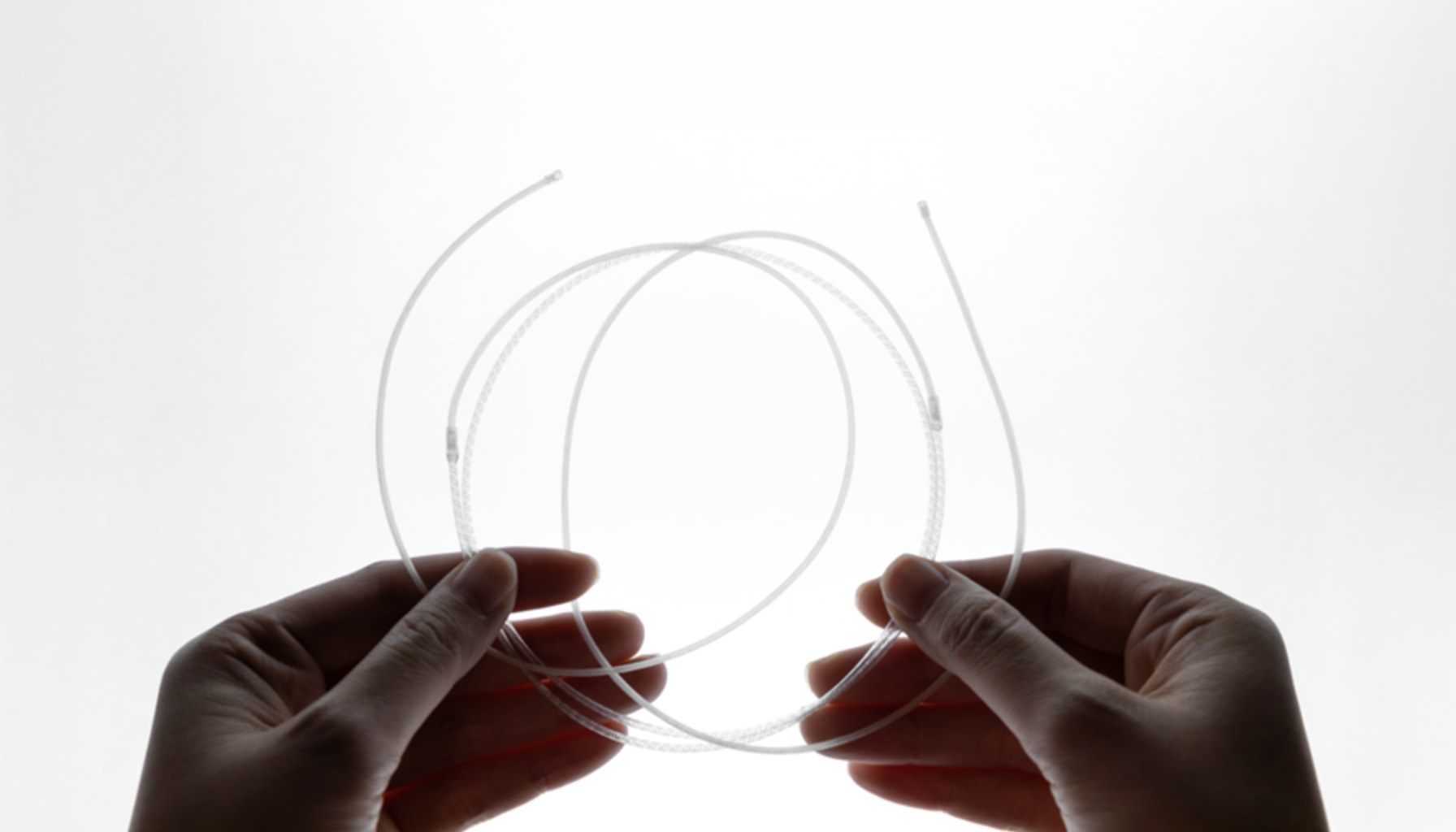
No motors, no pumps—just fiber muscles powering robots. MIT and Italy’s Politecnico di Bari unveil a new class of electrically driven artificial muscle fibers that promise to bend, twist, and grip with the quiet, compliant touch of real muscle.
Engineering documentation shows these electrofluidic fiber muscles sit at the intersection of soft robotics and wearable actuation. The team blends a fluidically driven thin McKibben actuator with a miniaturized solid-state pump based on electrohydrodynamics (EHD). The result is a fiber-format actuator that can be woven or bundled into configurations tailored to a task, rather than being shackled to bulky rotary motors and external pumps. Demonstration footage shows a line of fibers behaving like a controllable, stretchable muscle cluster, capable of producing force and motion directly where you want it, with none of the audible whine or hardware heft typical of traditional actuators.
The work, led by MIT Media Lab PhD candidate Ozgun Kilic Afsar and Politecnico di Bari professor Vito Cacucciolo, is reported in Science Robotics. The key leap is what happens when you remove the need for a pump or motor as a separate machine. By embedding a compact, solid-state pump into the fiber itself, the system generates pressure inside a sealed fluid compartment without moving parts or an external fluid supply. In plain terms: a muscle fiber that you could weave into a sleeve, a glove, or a soft gripper, and power with a simple electrical drive rather than a bulky hydraulic or pneumatic layout.
From a humanoid-robotics perspective, the potential perk is density and safety. Scalable fiber bundles can be configured to approximate the distributed actuation of human muscle, enabling higher degrees of freedom without proportionally larger hardware footprints. The fibers’ intrinsic compliance means contact with the operator or object is gentler, a meaningful advantage for hand manipulation, assistive devices, or close-proximity collaboration with people. Lab testing confirms that the actuation is quiet and intrinsically compatible with body-facing surfaces, a longstanding hurdle for implanted or wearable actuators. And because the actuation is electro-driven rather than motor-driven, there’s a clear path to reducing system inertia and backdriving in soft limbs.
But the reality check is necessary. What the MIT team demonstrates today is a compelling lab-level concept, not a field-ready humanoid arm. The Science Robotics publication frames this as a controlled-environment proof of concept, with the practical questions still hanging over it: how many fibers are needed to deliver real hand or wrist torque, how do you manage precise position feedback across a bundle of fibers, and how will reliability hold up under repeated loading and temperature fluctuations? The technical specifications reveal a run-time profile that depends on the power source driving the integrated fiber pump, and while the architecture eliminates external pumps, it introduces a new set of materials- and fluid-management questions that engineers will need to solve before a humanoid-grade limb can be built around it.
Two to four takeaway insights for practitioners stand out. First, actuation density versus control complexity is the core tradeoff: weaving more fiber muscles into a limb increases potential DOF, but it also multiplies the sensing and feedback channels required for stable, repeatable motion. Second, durability remains a risk: liquid-encased, fiber-based actuators can suffer fatigue, creep, or leakage if the fluid seal degrades, and the EHD pump’s behavior under long cycles and elevated temperatures is not yet fully characterized. Third, integration economics matter: the most compelling future here is a seamless, fiber-based actuation layer that can be manufactured at scale and integrated with lightweight on-board power, sensors, and control — not an on-paper miracle. Fourth, power and thermal management will dictate real-world viability: even with no external pumps, the fiber’s electrical drive and internal pumping draw energy and generate heat, which must be dissipated in a humanoid’s compact form factor.
Compared to prior soft-actuator generations that relied on bulky pumps and external plumbing, this fiber approach offers a clear improvement in integration potential and quiet operation. The leap is less about dramatic horsepower changes and more about orchestration: turning a roomful of fibers into a controllable, muscle-like array that can be placed precisely where you need it on a robot’s frame. If the field tests confirm scalable manufacturing and robust endurance, the path from lab curiosity to humanoid backbone may become more plausible—though still likely several years from a production-ready product.
Power, runtime, and charging details remain to be disclosed at scale, and the work will hinge on how quickly researchers can translate a few-meter fiber lab rig into multi-kilometer manufacturable strands with predictable behavior in real devices. For now, the message is clear: a quiet, body-friendly actuation option exists, and it could reshape how future humanoids think about muscle-like control—one fiber at a time.
- A new type of electrically driven artificial muscle fibernews.mit.edu / Primary source / Published APR 09, 2026 / Accessed APR 09, 2026