Google DeepMind pushes Gemini Robotics 2 toward whole-body humanoid control
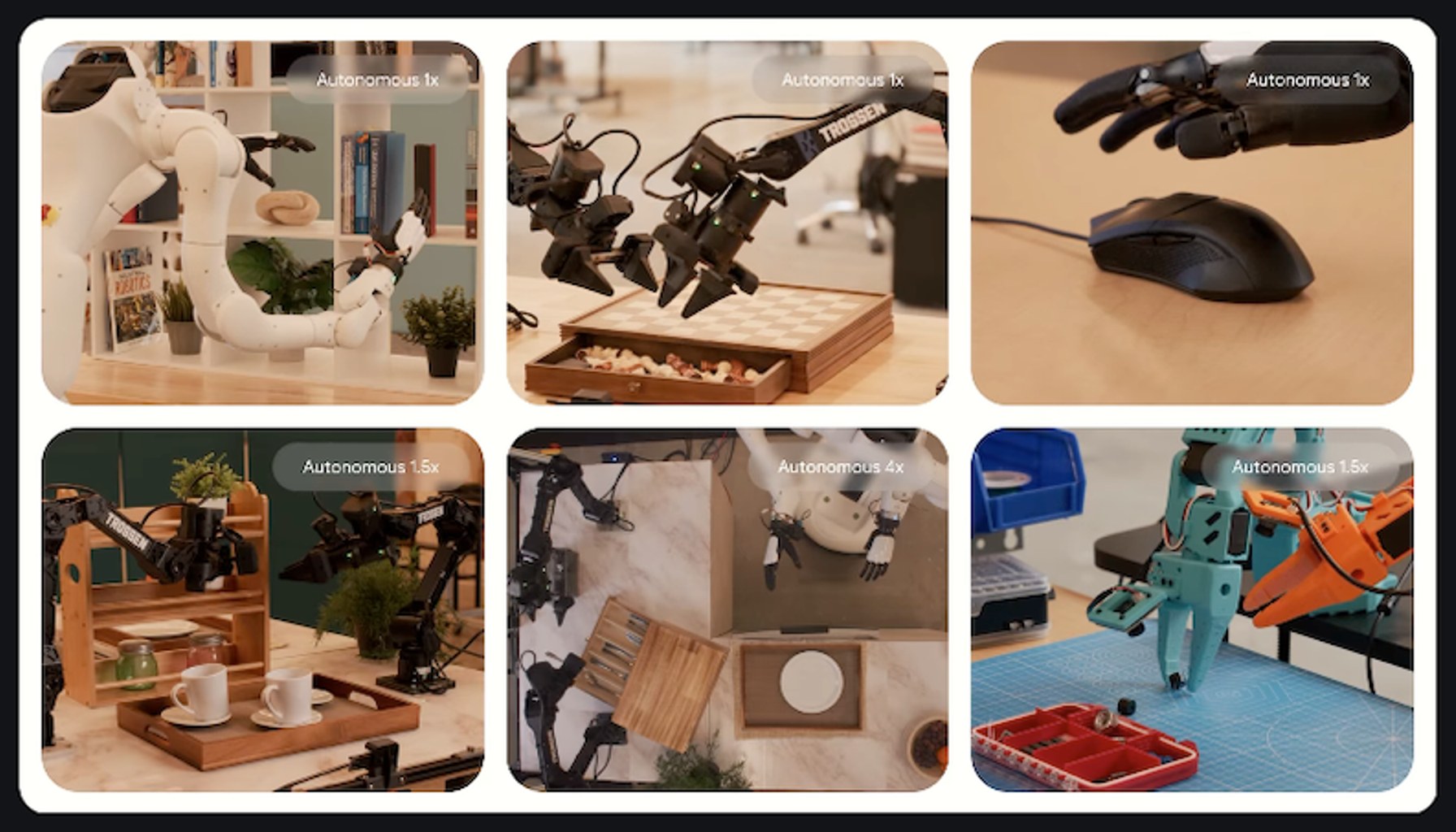
Image / roboticsandautomationnews.com
Apptronik’s Apollo 2 is now the public face of a system that aims to move robots from scripted motions to task-level autonomy — but the release still sits squarely in the early-access, partner-demo stage.
What Google DeepMind actually released
Google DeepMind has launched Gemini Robotics 2, a new suite of models intended to give robots more autonomy across whole-body movement, dexterous manipulation, and collaboration between multiple robots.
The release is not a single model so much as a stack. According to Google DeepMind, Gemini Robotics 2 is the vision-language-action model that turns visual and language inputs into robot motions. Gemini Robotics ER 2 handles embodied reasoning, including multi-step planning and coordination with people and other robots. Gemini Robotics On-Device 2 is a local version designed to run on robot hardware when cloud connectivity is limited.
That architecture matters. In practical terms, robotics deployments rarely fail because one part of the stack is elegant. They fail when perception, planning, actuation, and runtime constraints do not line up in the same environment. Google DeepMind is clearly aiming to cover more of that chain in one platform.
Apollo 2 shows the payload: feet to fingertips
The demonstration platform is Apptronik’s Apollo 2 humanoid robot, which Google DeepMind says can now perform full-body autonomous movements, including walking, crouching, bending, and manipulating objects while reasoning through complex tasks in real time.
The company describes Gemini Robotics 2 as an “intelligence layer” for robots, meant to move machines beyond pre-programmed tasks and toward adaptation in changing environments. In the demo, Apollo 2 is instructed to “put the watering can into the green bin in the bottom shelf,” then walks across the room, picks up the object, and places it in the right location.
For engineers, the important detail is not that the robot walked; it is that the model is being presented as capable of coordinating motion from “feet to fingertips.” That is a meaningful shift from upper-body-only manipulation, which has been the more common limit for many robot AI systems. Whole-body control changes the control problem from isolated arm movements to balancing, locomotion, grasping, and task execution at once.
Google DeepMind also says the system supports Apptronik’s Apollo 2 equipped with five-fingered SharpaWave hands for tasks such as tying a trash bag or unscrewing a light bulb. It also supports conventional parallel grippers for industrial work, including precision insertion and packing.
Dexterity is the headline, but runtime is the real test
The demo set is strong on dexterity, but deployment will be judged on runtime, not just motion clips. Google DeepMind says Gemini Robotics ER 2 is designed to manage task execution over several minutes, monitor progress, recover from failures, and adapt to changing situations.
That is the kind of claim that matters in warehouses, light manufacturing, and service environments. Many robotics systems can complete a scripted sequence once in a controlled setting. Fewer can keep state over time, notice when a part slips, handle an unexpected obstacle, or decide when to stop and ask for help.
The reasoning model is also meant to enable robots to communicate with people and coordinate with other robots. Google DeepMind says that multi-robot collaboration allows different robot types to work together on workflows that would otherwise require one machine to perform every task. In other words, the system is being positioned not just as a single humanoid controller, but as an orchestration layer for mixed fleets.
That broadens the addressable market, at least in theory. It also raises the bar. Interoperability across robot types is hard enough in a lab; in deployment, it has to survive inconsistent sensors, different graspers, varied floors, changing payloads, and site-specific safety rules.
On-device adaptation is aimed at the deployment gap
Google DeepMind says Gemini Robotics On-Device 2 runs directly on robot hardware and can be adapted to new dual-arm robot platforms with fewer than 200 training examples collected over just a few hours. The company says the platform can be adapted to new hardware in a matter of hours.
That is the most deployment-oriented claim in the release. If it holds up, it reduces one of the standard bottlenecks in robotics: collecting enough task-specific data to make a model useful on a new body in a new environment. In practice, robot deployments often stall because every new end effector, fixture, or workstation becomes a new integration project.
Running locally also matters where cloud connectivity is weak, intermittent, or disallowed. Industrial operators care about latency, privacy, and uptime. An on-device model is not just a convenience; it can be a requirement when a robot must keep working without a reliable network link.
Still, “fewer than 200 training examples” should be read as a partner-access claim, not a general deployment guarantee. The real test is whether that level of adaptation holds across sites, loads, and long-tail edge cases once a robot leaves the demo floor.
Safety is getting a benchmark, not just a talking point
Google DeepMind has also introduced ASIMOV-Agentic, a benchmark for evaluating what it calls “agentic safety orchestration and uncertainty resolution.” The benchmark measures whether a robot refuses unsafe actions, recognizes when a task cannot be completed safely, and requests human intervention when needed.
That emphasis is important because autonomy and safety are coupled, not separate. The more a robot can improvise, the more important it becomes that it knows when not to proceed. For humanoids in particular, full-body motion introduces obvious human-safety risks: a wrong step, an unexpected turn, or a poorly judged reach can put nearby workers in the path of hardware with real mass and momentum.
Google DeepMind says Gemini Robotics ER 2 also improves human-awareness capabilities. The model can detect nearby people, trigger safety functions, and stop safely when someone enters the robot’s working area. That is the right direction for deployment reality, where human traffic is the norm rather than the exception.
A benchmark is not a safety system, but it is a sign that the company knows the field is moving from performance demos toward operational constraints.
What this means for humanoids in the near term
Google DeepMind says Gemini Robotics 2 and Gemini Robotics On-Device 2 are available to selected early-access partners, while Gemini Robotics ER 2 is available through Google AI Studio and in private preview on the Gemini Enterprise Agent Platform.
That release posture is telling. This is still a controlled rollout, not a broad commercial launch. The system is being shown on a humanoid platform with impressive whole-body behaviors, but the availability terms make clear that the software is not yet a general-purpose product for open deployment.
For operators, the useful takeaway is not that humanoids are “here,” but that the software stack around them is getting more serious about the hard parts: whole-body control, multi-step reasoning, on-device runtime, and safety gating. For investors, the signal is that the market is moving from robot body hardware alone toward the intelligence layer that can make a body useful.
The gap between lab demo and deployment remains large. But Google DeepMind’s Gemini Robotics 2 release suggests that the next phase of humanoid robotics will be judged less by whether a robot can move, and more by whether it can move, decide, recover, and stay safe in the same run.
- Google DeepMind unveils Gemini Robotics 2 as Apptronik humanoid demonstrates whole-body AIroboticsandautomationnews.com / Trade / Published JUL 31, 2026 / Accessed JUL 31, 2026