A preprint combines motion repair, physics-aware training, and one recovery policy on a 29-degree-of-freedom Unitree G1.
KungfuAthleteBot is a research pipeline for teaching a humanoid robot athletic movements from video. Instead of copying every human pose, it repairs unreliable motion, helps the robot learn physically possible actions, and trains one policy to resume movement after a fall.
Researchers at Beijing Institute of Technology and QIYUAN Lab describe the system in an October 2026 preprint. They report tests in simulation and on a physical Unitree G1. This is a lab research demonstration, not a consumer product or commercial deployment.
Why video alone fails
A video shows where a person’s body moves. It does not show the forces, motor commands, or balance corrections that produced that movement.
That difference matters during a flip or explosive strike. A human and a robot may follow similar joint paths, but their bodies, motors, weight distribution, and available torque differ. Demanding exact frame-by-frame tracking can ask the robot to perform a movement its hardware cannot produce.
Video reconstruction creates another problem. A reconstructed body may appear to float during a jump, pass through the floor during landing, or jitter between frames. These are not minor visual defects. They can turn the reference motion into an impossible target for a robot controller.
The paper organizes its solution around three engineering problems: bad physical references, missing actuation information, and no recovery behavior.
First, it repairs the motion
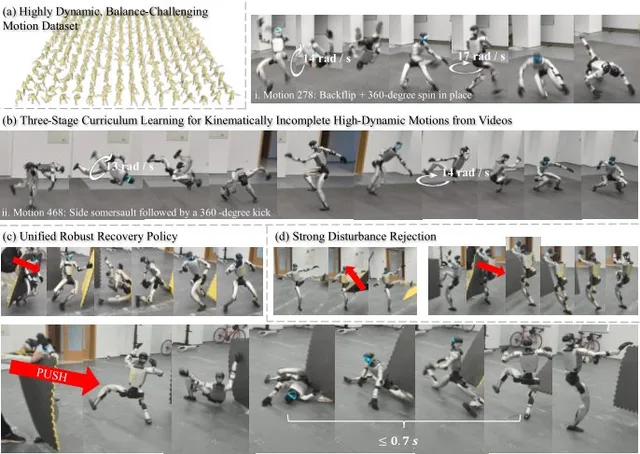
The KungfuAthlete dataset begins with 197 training videos of national-level martial artists. The researchers automatically split them into 1,726 sub-clips, reconstructed the movements, and retargeted them to the Unitree G1.
Retargeting means mapping human movement onto a robot with different joints and body proportions. The output is a reference: a motion the robot should try to follow, not a proven sequence of motor commands.
The repair process uses several specific corrections. It aligns the motion with the ground, removes body parts that penetrate the floor, replaces implausible jump-height changes with a ballistic path, and smooths high-frequency jitter. A ballistic path is the curved flight path expected under constant acceleration, such as gravity.
This matters most during aerial movement. If the reconstructed robot’s root, or central body position, “floats” instead of following a realistic flight arc, no controller can reliably treat that motion as physically valid.
The process is not fully automatic. The paper says ambiguous local low points still require manual annotation. In practical terms, a person may need to help identify whether a detected low point represents a real contact with the ground or an error in the reconstructed motion.
Second, it avoids impossible starting points
Robot controllers often learn through trial and error in simulation. They start from different states, apply motor actions, and receive rewards for tracking the reference while remaining stable.
For video-derived motion, ordinary error-based sampling can make learning worse. If the robot performs badly at an aerial pose, a system that focuses on the largest tracking errors may keep restarting at that same infeasible pose.
KungfuAthleteBot instead uses pseudo-low-kinetic-energy sampling. Kinetic energy here means movement-related energy, estimated from joint speeds, body motion, and body rotation. The sampler favors reference frames that are easier for the robot to approach while still covering important parts of the action, including takeoff and landing.
This does not give the robot the human performer’s forces. It gives training a better starting distribution, allowing the policy to discover its own motor strategy rather than blindly imitating impossible joint behavior.
The researchers also use a three-stage curriculum. First, the policy explores broadly. Next, it faces tighter tracking requirements. Finally, training varies conditions such as pushes, friction, mass, gravity, and starting states. The paper uses these changes to prepare the controller for the difference between simulation and a physical robot; the reported experiments do not establish that this approach will transfer equally well to other machines.
Third, one policy handles motion and falls
A controller that works only while the robot stays upright is fragile. A robot can be pushed, lose balance, or land poorly, while the original video says nothing about what happens next.
KungfuAthleteBot trains tracking and recovery together. The same policy follows the reference, responds to disturbances, and recovers from gravity-driven falls. It does not require a separate recovery reference or a person to switch manually into a get-up mode.
On the physical Unitree G1, the paper reports recovery from four fall families: prone, supine, lateral, and twisted configurations. The robot then resumed the tracked motion. Under the paper’s recovery protocol, the reported average was about 0.7 seconds, specifically 0.692 seconds with a 0.136-second spread across the reported trials.
That figure describes the authors’ selected robot, fall states, motions, and test procedure. It is not a general safety guarantee. A faster recovery can also increase mechanical stress and create risks for nearby people or objects.
What the demonstration does—and does not—show
The paper reports simulation and real-hardware experiments on the 29-degree-of-freedom Unitree G1. In one benchmark, KungfuAthleteBot tracked seven challenging motions, including flips, strikes, one-legged movement, and a long Tai Chi sequence. The researchers report six successful trials out of six for the system on each listed motion.
The underlying dataset includes ground actions and jumping actions. The paper describes 848 screened motion samples stored as robot joint-position data at 30 frames per second. Its project page is described as hosting code, training configurations, and a recovery checkpoint, while the paper also says the dataset, code, and checkpoint will be published under an MIT license upon acceptance. That makes the final release status unclear.
The work also remains tied to one evaluated humanoid platform and the authors’ motion and fall protocols. The record does not establish independent replication, performance on other humanoids, or behavior in unscripted public settings.
Why the approach matters
The main engineering lesson is that more video alone will not solve humanoid control. Video must first be repaired into motion the robot can approach, and the controller must learn what to do when the reference becomes unreachable.
KungfuAthleteBot treats those as one systems problem: repair the reference, start learning from more feasible states, and build recovery into the tracking policy. The next meaningful test is independent reproduction across different robots, athletic motions, and unexpected falls.