New metric maps molecular AI OOD risk
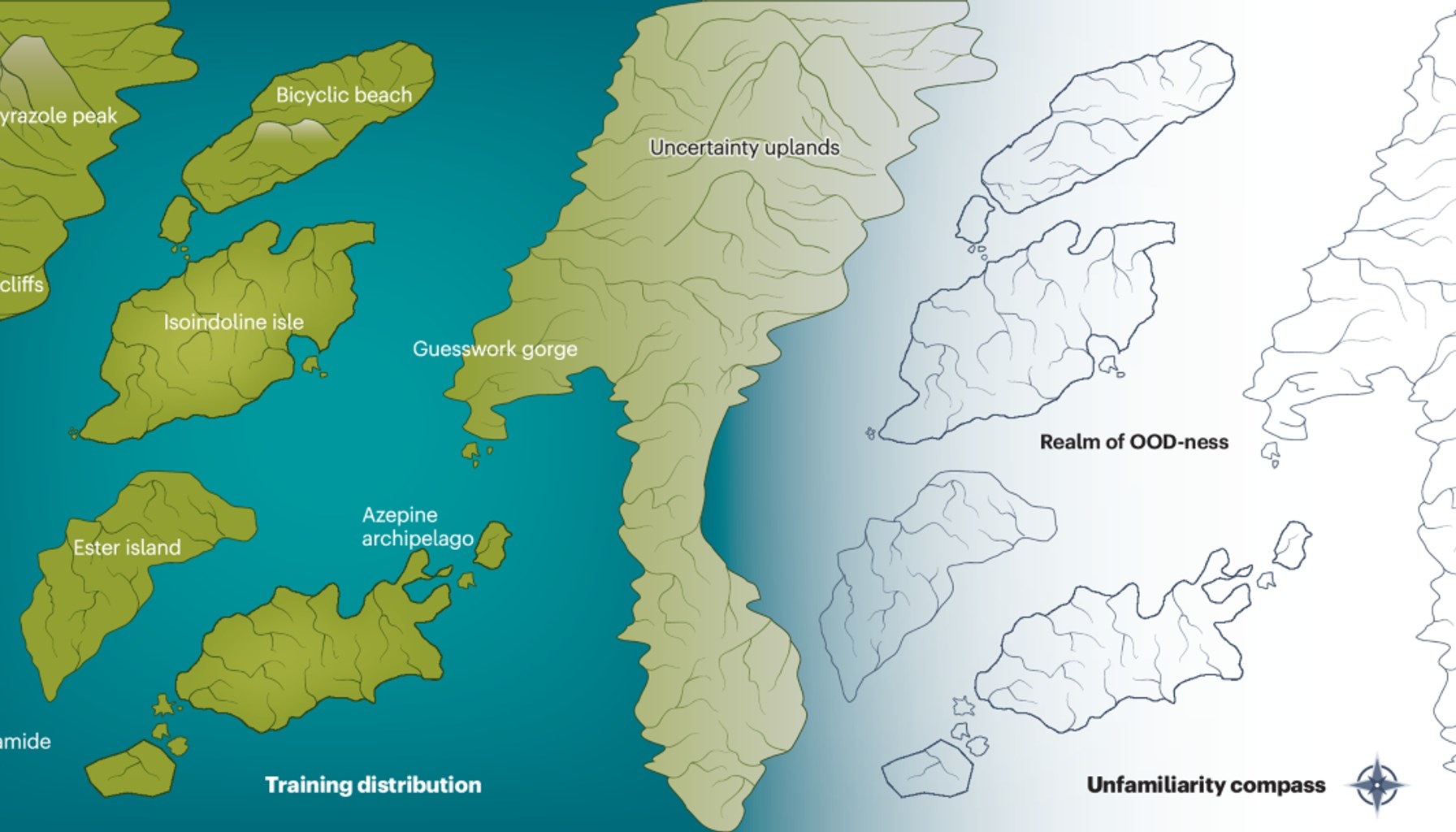
A single score now tells you when drug predicting models fail out of distribution.
The Nature Machine Intelligence paper Navigating molecular OOD-ness introduces a metric that quantifies chemical distribution shift and pairs it with model performance to judge how well a molecular ML system will generalize beyond its training data. The team reports that this score can compare how different models hold up as they encounter unseen chemistry, offering a practical lens for vetting AI in drug discovery rather than relying solely on traditional held-out test sets.
In practice, the metric measures how far a candidate molecule sits from the training distribution and correlates that distance with the model’s confidence or error on that molecule. The result is a tool that helps teams separate real predictive signal from spurious patterns tied to familiar chemistries. The paper shows that high accuracy on conventional splits can still mask brittleness when the models face novel scaffolds or rare chemotypes, a common pitfall in cheminformatics where the training data cannot cover the vastness of chemical space.
Benchmarks indicate the score tracks generalization risk across several molecular ML tasks, enabling a more robust assessment of readiness for real drug discovery workloads. By highlighting where a model may overfit to the seen data, the metric pushes teams to broaden training sets or adjust evaluation protocols. The paper emphasizes that distribution shift, not just predictive error, should drive model selection and risk assessment as pipelines move toward practical applications.
The engineering take is straightforward: measuring OOD risk is a practical complement to accuracy, but it comes with constraints. The report does not foreground parameter counts or model architectures; the focus is on data distribution and its impact on generalization. For teams, that shifts the vetting workflow from “which model scored best on held-out data” to “how does this model perform as chemistry moves off the familiar map.” The team reports that incorporating this metric into benchmarking routines helps surface latent weaknesses before late stage, costly experiments.
From a practitioner standpoint, there are clear constraints to manage. First, data diversity remains the decisive lever; the metric will only reveal OOD risk if the training set and reference distributions cover enough of chemical space. The paper suggests that teams adopt multiple, carefully chosen distribution shifts to stress-test models rather than rely on a single held-out library. Second, there is a tradeoff in workflow modesty versus insight: adding distribution-shift scoring could slow iteration unless integrated tightly into CI pipelines or model eval suites. Third, the method invites scrutiny of why a model fails: is the error due to novel chemistry, or to biases in representation, featurization, or sampling? The article frames OOD assessment as a diagnostic step, not a silver bullet.
Looking ahead, the uptake will hinge on standardizing how OOD shifts are defined across labs and on how benchmarks align with real discovery outcomes. If the metric proves stable across libraries and tasks, it could become a norm for early-stage model vetting, reducing the risk of costly misfires when moving from in silico hits to experimental validation. In the near term, teams will watch for broader adoption, additional benchmarks, and guidance on integrating the score with existing drug discovery workflows.
- Navigating molecular OOD-nessNature Machine Intelligence / Primary source / Published JUN 08, 2026 / Accessed JUN 14, 2026