OpenAI says GPT-5.6 aims to lower the cost of useful intelligence
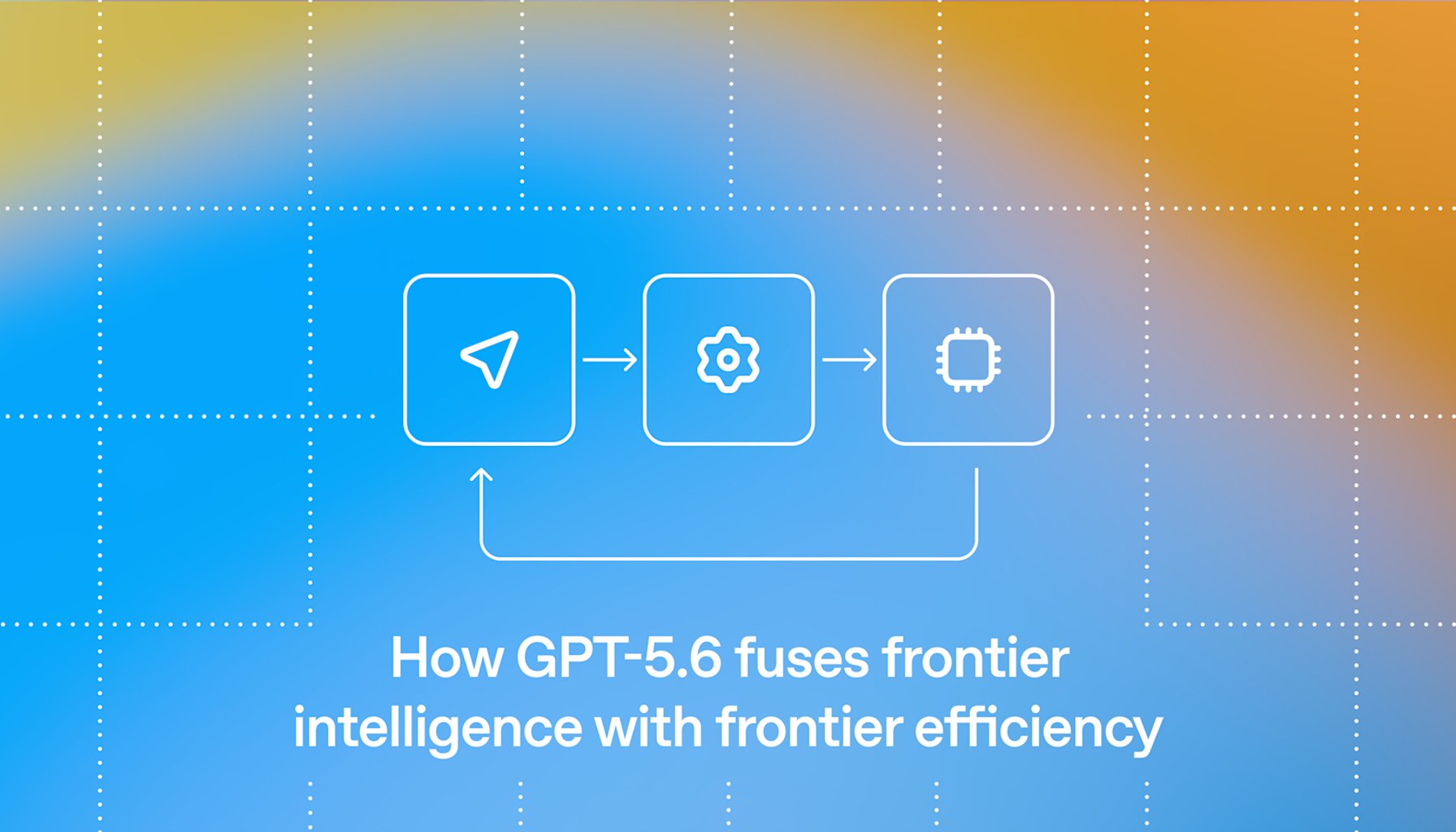
Image / openai.com
OpenAI says GPT-5.6 is designed to improve efficiency across models, inference, and agentic workflows, with the goal of delivering more useful intelligence per dollar.
Efficiency, not just capability
OpenAI says GPT-5.6 is built around a practical problem that matters to engineers and product teams: how to get more useful output from AI systems without paying proportionally more for it. In a post published on July 29, 2026, the company described the model as fusing “frontier intelligence” with “frontier efficiency,” and said the improvements span models, inference, and agentic workflows.
That framing matters because most production AI deployments are constrained less by headlines and more by budgets, latency, and reliability. A model that is slightly better on benchmark tasks but significantly cheaper to run can change what teams can afford to ship. OpenAI’s emphasis on “more useful intelligence per dollar” points directly at that tradeoff.
The company did not provide benchmark numbers in the material available here, but the message is clear: the update is about operational efficiency as much as raw capability. For teams choosing where to spend, that puts the focus on the total cost of using AI at scale, not just the quality of a single response.
What OpenAI says changed
OpenAI says GPT-5.6 improves efficiency across three layers of the stack.
First, it targets the model itself. That suggests the company is trying to make the underlying system do more with the same or less compute. For practitioners, this is the part that can affect token usage, throughput, and model selection decisions.
Second, the company points to inference. In production settings, inference is where most real costs show up: every request, every streamed token, every retry, every tool call. If a model reduces inference cost or improves throughput, the impact is immediate. It can mean lower serving bills, better latency, or more room to scale usage without changing the architecture.
Third, OpenAI says GPT-5.6 improves “agentic workflows.” That is a signal that the company sees value not only in chat-style responses but in multi-step systems that plan, call tools, and complete tasks. These workflows tend to be more expensive than simple Q&A because they generate more intermediate actions and more model calls. Efficiency gains here could matter as much as raw benchmark gains, because agent systems are often where costs multiply fastest.
The headline claim is not that GPT-5.6 does something qualitatively new. It is that the system is more efficient across the chain from model behavior to deployment patterns. For product teams, that is the kind of improvement that can unlock broader use rather than a single demo.
Why this matters for deployment decisions
In practice, AI adoption is often a contest between ambition and unit economics. Teams want capable models, but they also need predictable cost envelopes, acceptable latency, and enough headroom to serve real traffic. OpenAI’s positioning of GPT-5.6 suggests the company is trying to address exactly those constraints.
If a model delivers “more useful intelligence per dollar,” then the most important effect may be expansion in viable use cases. Workflows that were too expensive to run continuously may become feasible. Applications that needed aggressive prompt trimming or heavy caching may get simpler. Product managers may find it easier to justify assistant-style features, internal copilots, or automated agents if the cost per completed task falls.
There is also a strategic implication for platform teams. Efficiency improvements can change how models are selected and routed. A system that is cheaper and faster may become the default for broader traffic, while a more expensive model is reserved for the cases that truly need it. That kind of tiering is often how AI actually gets deployed: not one model to rule them all, but a stack of tradeoffs matched to task difficulty and cost.
OpenAI’s announcement is therefore less about a single breakthrough than about making AI more operationally usable. The practical question is not whether the model sounds impressive, but whether it improves throughput, lowers serving cost, and reduces the engineering friction around agentic systems.
Benchmarks still matter, but so do economics
OpenAI’s published description emphasizes efficiency, but the absence of benchmark details in the available material means buyers will still need to test the model against their own workloads. That is standard practice in enterprise AI. A vendor can claim better intelligence per dollar, but the real question is whether the gain appears on your tasks, with your prompts, your tools, and your latency constraints.
This is where benchmark scores, if and when they are published, will matter. Teams should look at not only accuracy and reasoning quality, but also cost per successful task, response time under load, and the failure rate of multi-step workflows. A model that is 5% better on a benchmark but 20% cheaper to run is easy to understand. A model that is slightly smarter but slower, or cheaper but less dependable in tool use, is a harder tradeoff.
OpenAI’s emphasis on agentic workflows is especially important because agents fail in ways simple completion models do not. They can waste tokens, loop on tool calls, or produce brittle plans. Efficiency improvements here should be judged by task completion rates and total cost to finish a workflow, not by first-turn answer quality alone.
For engineering leaders, the practical takeaway is to evaluate GPT-5.6 in the context of full system behavior. The relevant metrics are not just output quality, but cost, throughput, and operational stability. That is where efficiency becomes visible.
The real test is in production
OpenAI says GPT-5.6 is meant to increase useful intelligence per dollar, and that is a sensible north star for the market. But the real test will be whether customers can translate that claim into lower bills, better latency, or higher-quality automation in production.
That means the first question is not “Is this smarter?” It is “Does this let us ship more?” If the answer is yes, the model could become an attractive option for teams that have been constrained by compute costs or by the overhead of building agents that work reliably.
For now, the announcement points to a familiar pattern in AI infrastructure: the frontier is not only about bigger models, but about making the economics work. If GPT-5.6 does what OpenAI says, the benefit will show up less in slogans than in spreadsheets, service-level metrics, and the ability to run more useful workloads without expanding spend at the same rate.
- How GPT-5.6 fuses frontier intelligence with frontier efficiencyopenai.com / Primary source / Published JUL 28, 2026 / Accessed JUL 30, 2026