Shanghai Electric puts humanoids, robots, and AI factory software on display in Shanghai
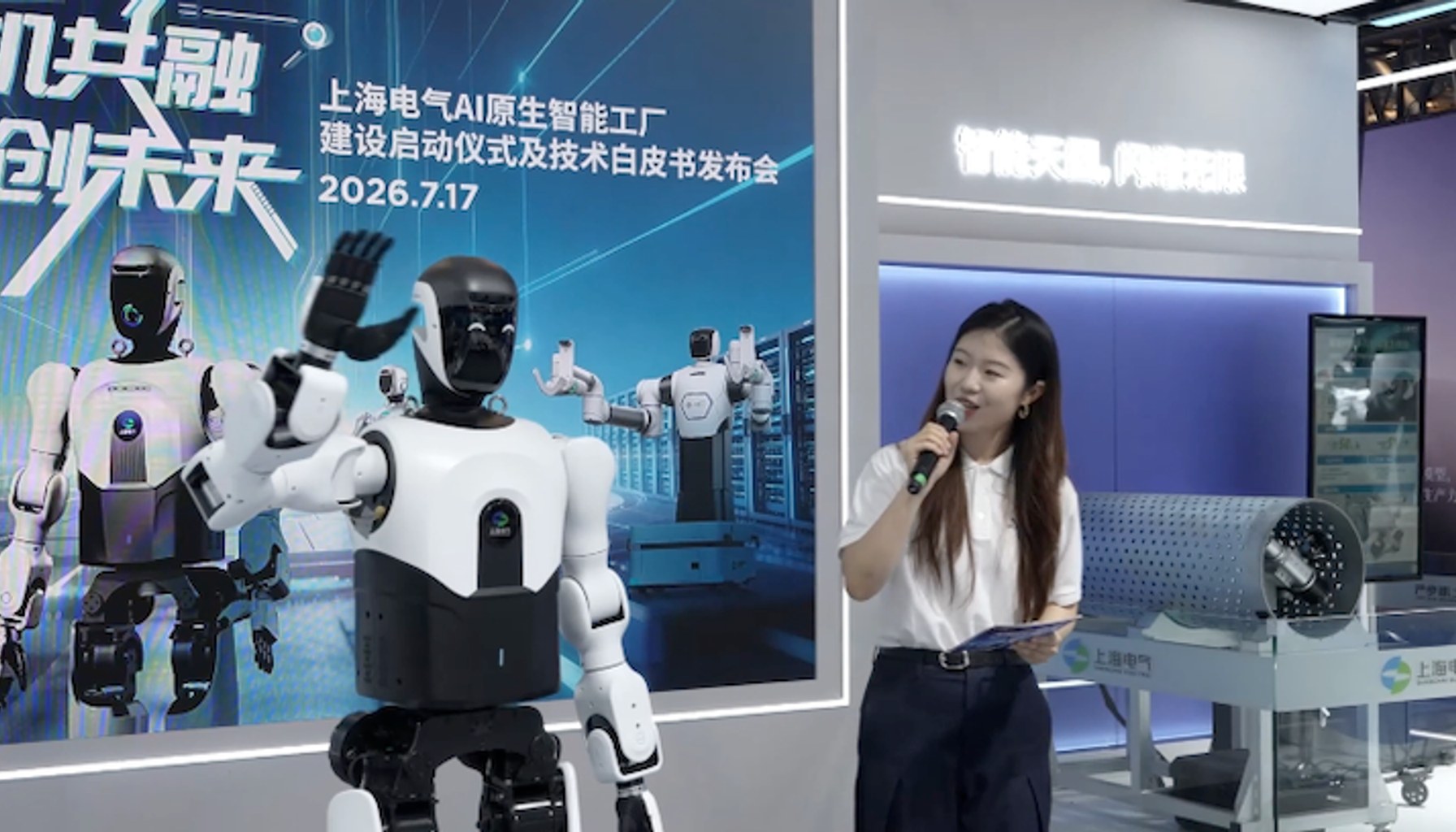
Image / roboticsandautomationnews.com
The company says its latest portfolio is aimed at real plant tasks: inspection, material handling, assembly, and maintenance, with industrial robots, dexterous hands, and AI agents built into an AI-native factory architecture.
A practical pitch for hard-to-automate work
Shanghai Electric used the 2026 World Artificial Intelligence Conference and High-Level Meeting on Global AI Governance in Shanghai to present a broad automation stack built for industrial use, not lab demos. The company showed embodied intelligence systems, core robot components, and AI-native smart factory software under the theme “AI for All: Smart Squad, Shining Without Limits.”
That matters because the most difficult manufacturing jobs are often not the highly repetitive ones. Shanghai Electric framed its offering around operations in high-end equipment manufacturing where workers and machines face confined spaces, complex objects, and tasks that demand steady precision over long periods. In plant terms, that is where automation usually earns its keep: reducing ergonomic strain, stabilizing output, and handling jobs that are difficult to staff consistently.
Wang Chunlei, deputy general manager of the robotics business unit at Shanghai Electric Automation Group, said the company’s approach is about combining “the strength, precision, and stability of machines with human experience and judgment” in a model of machine-assisted collaboration.
Four robot systems aimed at specific factory jobs
Shanghai Electric said its robotics portfolio spans five industrial scenarios: connector insertion, electrical operations, flexible sorting, intelligent assembly, and pipe processing. That is the right frame for buyers who think in throughput and uptime rather than novelty. The value of a robot is not that it can move; it is that it can repeat a defined operation at a stable rate, in a defined envelope, with manageable failure modes.
The company highlighted several systems:
SUYUAN, a bipedal humanoid robot, has 41 degrees of freedom, a multimodal visual sensing system on the head and torso, and a dual-battery hot-swap setup. Shanghai Electric said it is suited for inspection, material handling, and assembly tasks. For operations teams, hot-swap capability is notable because battery changeover can become a hidden downtime source in mobile robotics deployments.
TUOYUAN, an industrial wheeled humanoid robot, uses an embodied intelligence foundation model and force-position hybrid control. Shanghai Electric said it can handle multi-spec connector insertion, material sorting, and loading and unloading automotive sheet metal parts. Connector insertion is one of the classic automation headaches: high variability, tight tolerances, and frequent exceptions. If the machine can hold consistency there, that is where value begins to show.
Mermaid, a bionic wheeled humanoid robot, can identify buttons, knobs, and air switches autonomously and generate real-time operation paths. That points toward use in control-room or maintenance-type environments where an operator needs a machine to navigate around equipment and interact with conventional interfaces.
Autonomous pipe inner-wall chamfering robot targets confined spaces. Shanghai Electric said it can position and process thousands of hole edges with accuracy within 1 millimeter while transmitting data in real time. That combination of precision and data capture is attractive to plants that need both quality control and traceability, especially where manual work is slow, repetitive, and hard to inspect consistently.
Core components still matter to ROI
Plant managers know the robot is only one line item. The end effector, drive components, and motion hardware often determine whether the system makes money or becomes a maintenance burden. Shanghai Electric addressed that too, showing a portfolio of core components from power-output systems to end effectors.
Among them, the company said its planetary roller screw offers more than three times the load capacity of traditional ball screws. That kind of specification matters because higher load capacity can extend use cases, increase payload headroom, or reduce mechanical stress in demanding applications. But it also raises the usual integration questions: what is the duty cycle, how does it wear, and what spare parts strategy will the plant need?
Shanghai Electric also presented the DexHand dexterous hand, designed for a range of gripping and manipulation tasks. Dexterous hands are often where robotics pilots stall. The mechanics may work, but grasp reliability, part variability, and maintenance complexity determine whether the system survives contact with production reality. For operators evaluating such systems, the question is not whether the hand can perform a clever demonstration. It is how often it can complete the task without intervention.
AI agents move the conversation from robot demos to operations
Shanghai Electric said it launched 51 AI models and agents under its “StarCloud Intelligent Manufacturing” series across three domains: R&D and design, production and manufacturing, and operations and maintenance. The company said these agents cover process optimization and wind power facility maintenance and are embedded in robotic decision-making systems and the operational logic of AI-native smart factories.
That framing suggests a shift from isolated automation cells to software that supports the wider plant. The company said the agents support production-line scheduling, quality inspection, and predictive maintenance, moving manufacturing from experience-driven to data-driven operations. In practical terms, this is where buyers should focus on ROI. Scheduling, inspection, and maintenance decisions influence throughput, scrap, downtime, and labor utilization more directly than a robot’s marketing demo ever will.
Predictive maintenance only pays if the alerts are accurate enough to prevent unnecessary stoppages and early enough to avoid failure. Scheduling tools only help if they reflect actual constraints on the shop floor. Quality inspection only matters if it can lower escape rates or reduce manual recheck labor. The deployment evidence Shanghai Electric presented is promising in scope, but plants will still need to prove the model against their own processes.
The AI-native smart factory pitch
Shanghai Electric also released an “AI-Native Smart Factory Technology White Paper” describing an active evolution architecture for real-time, closed-loop optimization of production data. The company said the goal is a factory with self-perception, self-decision, and self-execution capabilities.
Its architecture has three layers: an AI factory brain as the control center, industrial agents and embodied robots as the execution network, and a physical twin as the digital mirror. Shanghai Electric said the design integrates process flows, industrial software, agents, and smart equipment to break down traditional hierarchies and bridge data silos.
For plant leaders, this is less about buzzwords than about operating discipline. Closed-loop control only works when the underlying data is reliable and the exceptions are understood. If sensor quality is poor, if the software model does not match the physical process, or if the robot cannot handle common part variation, the system will not scale. The upside, if it does work, is a production environment that can respond faster to disturbances and reduce the gap between planning and execution.
What to watch before deployment
Shanghai Electric said it will continue pushing AI into industrial settings, tackling embodied-intelligence challenges in complex scenarios, and accelerating large-scale deployment of AI-native smart factories with replicable solutions across manufacturing environments.
That is an ambitious roadmap, but automation buyers should test it against the same criteria they use for any capital project: throughput lift, labor offset, quality improvement, and maintenance burden. The strongest use cases Shanghai Electric showed are the ones with clear physical constraints and measurable outcomes — pipe processing, connector insertion, inspection, material handling, and scheduling support.
The real test now is not whether the systems can be demonstrated at a conference. It is whether they can be installed, supported, and kept productive on a live plant floor.
- Shanghai Electric unveils humanoids and industrial robots and AI smart factory technologiesroboticsandautomationnews.com / Trade / Published JUL 30, 2026 / Accessed JUL 30, 2026