Piper decouples training strategy from runtime
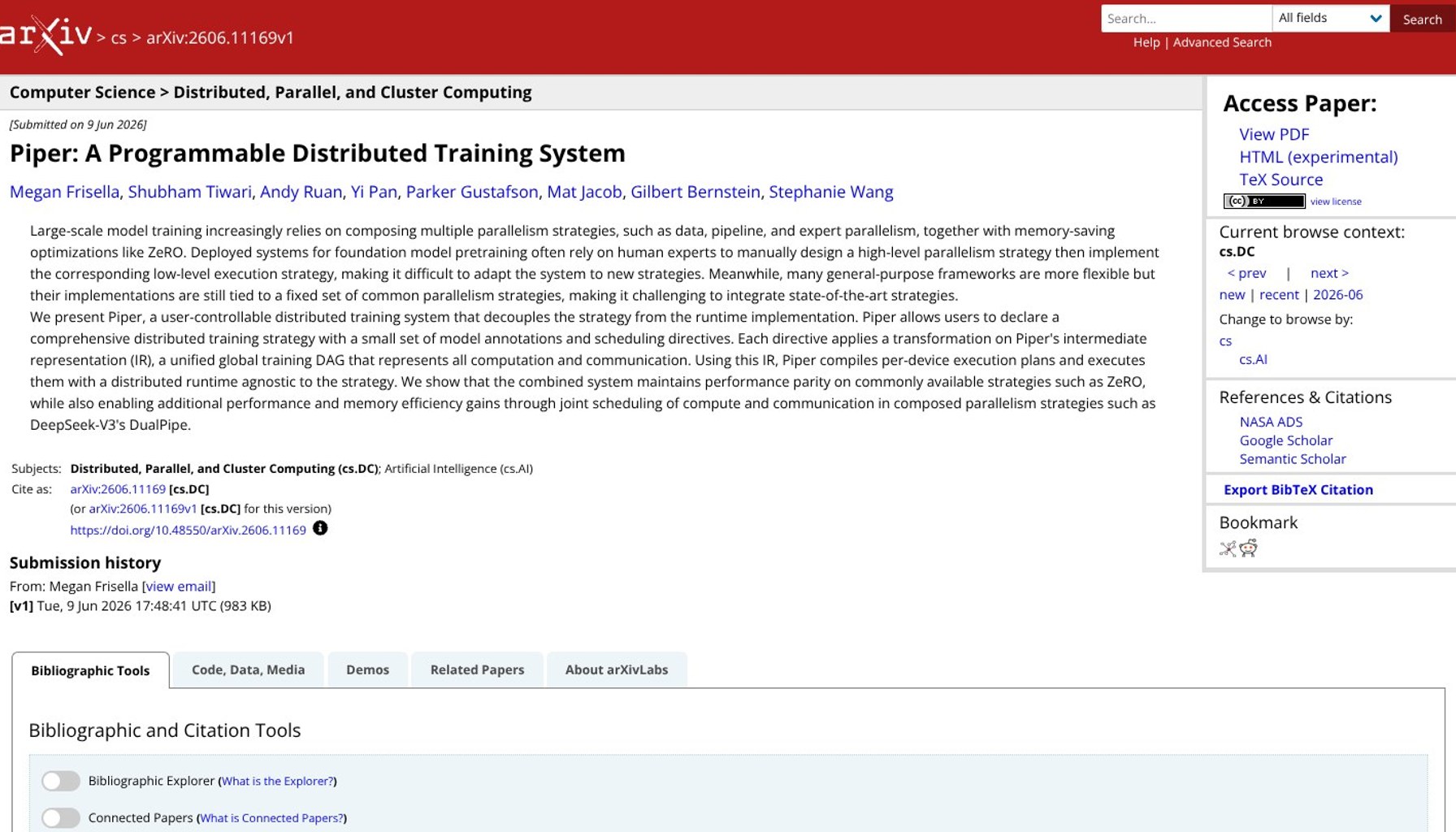
Declare a training strategy and Piper compiles the rest. That is the core idea behind the new programmable distributed training system, which lets researchers describe a full parallelism plan with a handful of annotations and scheduling directives, then hands the rest to a unified compiler and runtime.
Piper’s design treats strategy as a first class citizen, not an afterthought tacked onto a fixed runtime. In practice, users annotate models and specify how data, pipeline, and expert parallelism should be orchestrated, while memory saving techniques such as ZeRO are folded into the same planning surface. The system then builds a global view of the training workflow, an intermediate representation that behaves like a single, unified training DAG. From that IR, Piper compiles per-device execution plans and drives a distributed runtime that is agnostic to the exact strategy being employed. The result is a clean separation: you change how you want to run the training, and Piper rewrites the execution path without reworking the runtime engine itself.
At the heart of Piper is a commitment to a single, flexible surface for both compute and communication. The directives act on the IR to produce device-level plans, effectively turning strategy design into a form of program design. That IR captures dependencies and data flows across all participating devices, then the runtime takes care of launching the necessary communications and computations in a way that should feel familiar to teams already using traditional parallelism layouts. Benchmarks in the paper show that this approach preserves performance parity on commonly used strategies like ZeRO, while also enabling new opportunities for optimization through joint scheduling of compute and communication. In particular, the authors point to composed parallelism patterns such as DeepSeek-V3's DualPipe as an area where Piper can unlock additional performance and memory efficiency gains.
From a practitioner standpoint the shift is meaningful for how teams think about training infrastructure. First, decoupling strategy from runtime can dramatically shorten the cycle time to prototype new parallelism patterns. Rather than rewriting low-level execution logic, engineers can tweak the high level strategy and rely on the compiler to generate the per-device plans. Second, the integration of memory-saving techniques within the same planning surface lowers the friction of combining data, pipeline, and expert parallelism with ZeRO style optimizations. Third, the approach raises the bar for tooling and observability. If the IR and the generated plans are to be trusted, teams will want strong correctness checks, visibility into how dependencies map to device computations, and robust debugging tools for complex scheduling scenarios. Finally, the business incentive is clear: if a single IR can express multiple strategies and still deliver parity with established baselines, research groups and production teams gain flexibility to experiment with less engineering debt and faster iteration cycles.
Looking ahead, the most telling signs will be adoption and engineering discipline. Will major frameworks embrace a strategy-to-runtime separation at scale, and can the IR capture even more exotic parallelism patterns without exploding complexity? The Piper paper shows a promising path: a programmable, strategy-agnostic core that preserves known baselines and invites new efficiency through coordinated compute and communication scheduling. If those promises hold in practice, teams may increasingly treat strategy design as a programmable capability rather than a bespoke, hand-tuned craft tailored to a single model or hardware setup.
- Piper: A Programmable Distributed Training SystemarXiv LLM/Foundation Query / Primary source / Published JUN 09, 2026 / Accessed JUN 10, 2026