Real world data fuels robotic dexterity push
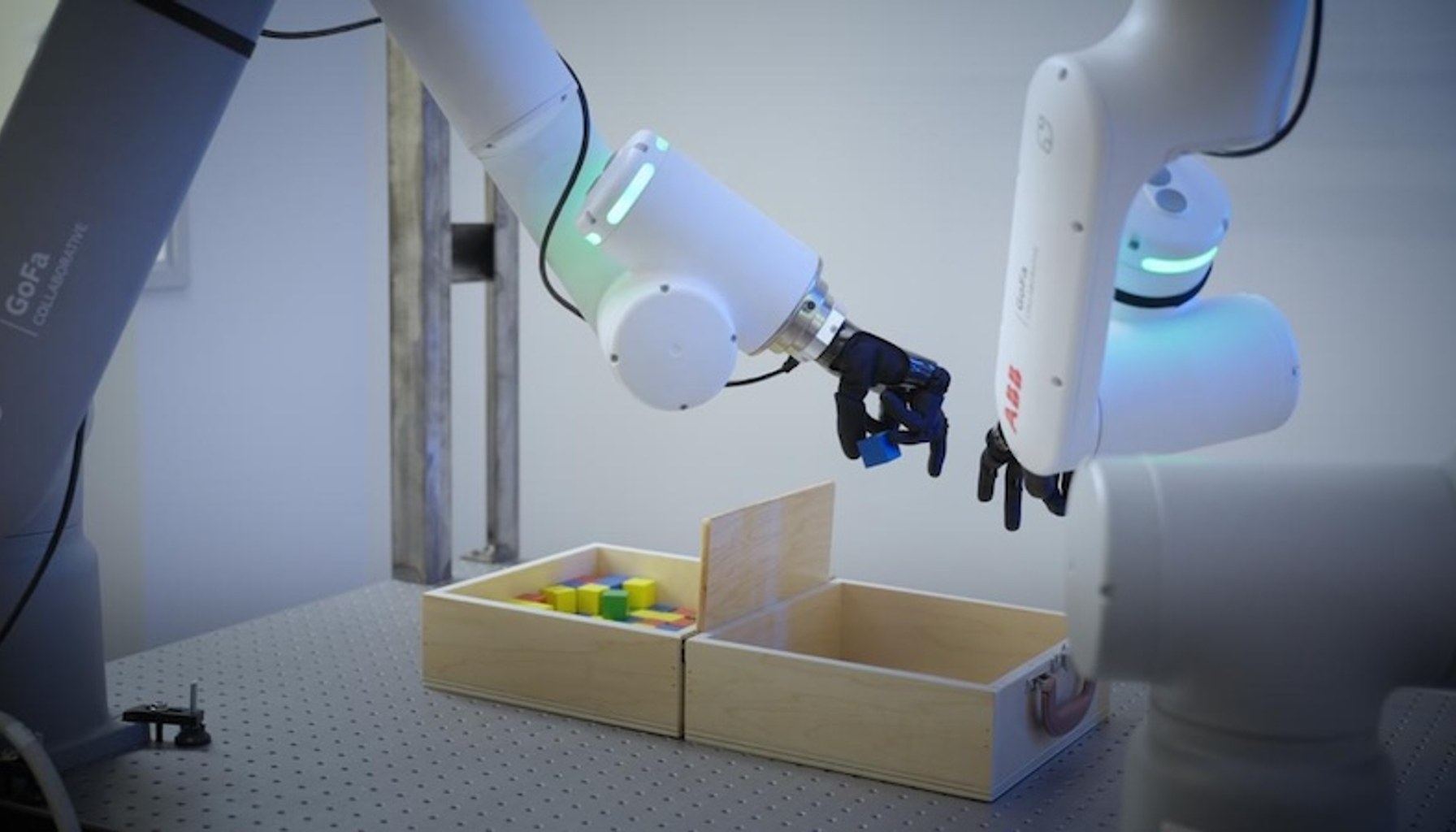
Image / Robotics & Automation News
Prosthetic data supercharges ABB's GoFa grip. ABB Robotics is partnering with Psyonic to teach grippers using human-generated data from prosthetic use. Testing shows dexterity gains that cut engineering time by up to 30%. The collaboration pairs the Psyonic Ability Hand with the ABB GoFa cobot to anchor learning in real world manipulation rather than synthetic tasks. Dexterity remains a major challenge for industry, and the goal is to translate the nuances of human grip into reliable robotic handling.
The setup leverages real world manipulation data gathered from human prosthetic use to refine how the GoFa learns to grip, lift, and position objects. The company reports that this data-driven approach helps the robot capture subtleties in contact dynamics that are hard to reproduce in lab-only simulations. In practice, that means better success rates on a broader variety of objects, from delicate components to irregularly shaped items, without hand-tuning every new task from scratch. Documentation indicates the method is already showing practical benefits in early task trials, reducing the amount of bespoke programming traditionally required to achieve robust grasps.
From a practitioner’s lens, several realities emerge. First, data quality and diversity matter: the more coverage the system has across object types, sizes, and surface textures, the more transferable the learned dexterity becomes. Second, there is a tradeoff between faster engineering cycles and the overhead of collecting, annotating, and curating real world manipulation data. While the payoff is lower programming effort, teams must invest in data pipelines and validation to prevent biased or non-generalizable behaviors from creeping into production. Third, safety and reliability are non negotiable when end-effectors operate in dynamic environments; misgrips or unexpected force could damage parts or harm operators if not properly contained. Fourth, the work sets up a clear watch point for the industry: how well these human-informed policies scale to other end-effectors and tasks, and how quickly the data platform can be extended to new grippers, payloads, or tool configurations.
Industry watchers say the approach reflects a broader shift from purely synthetic training toward human-in-the-loop data that captures real-world variability. If the gains hold as the program scales, manufacturers could see a meaningful acceleration in bringing dexterous automation to assembly lines, warehousing, and service robotics. Yet observers caution that the speed of adoption will hinge on how well ABB and Psyonic can standardize data collection, manage the calibration between prosthetic-derived signals and industrial hardware, and prove consistent performance across unseen objects and tasks.
As labs move from proof of concept to near-market pilots, the question will be how far this data-driven dexterity can travel without sacrificing safety or reliability. If the 30 percent engineering-time reduction proves durable across more tasks, this collaboration could become a blueprint for turning human grip nuance into scalable robotic competence, one data point at a time.
- ABB Robotics and Psyonic use human-generated data to advance robotic dexterityRobotics & Automation News / Trade / Published JUN 26, 2026 / Accessed JUN 26, 2026