SageMaker JumpStart Adds NEXUS for Tabular Data
Deterministic tabular predictions, delivered in days, not months.
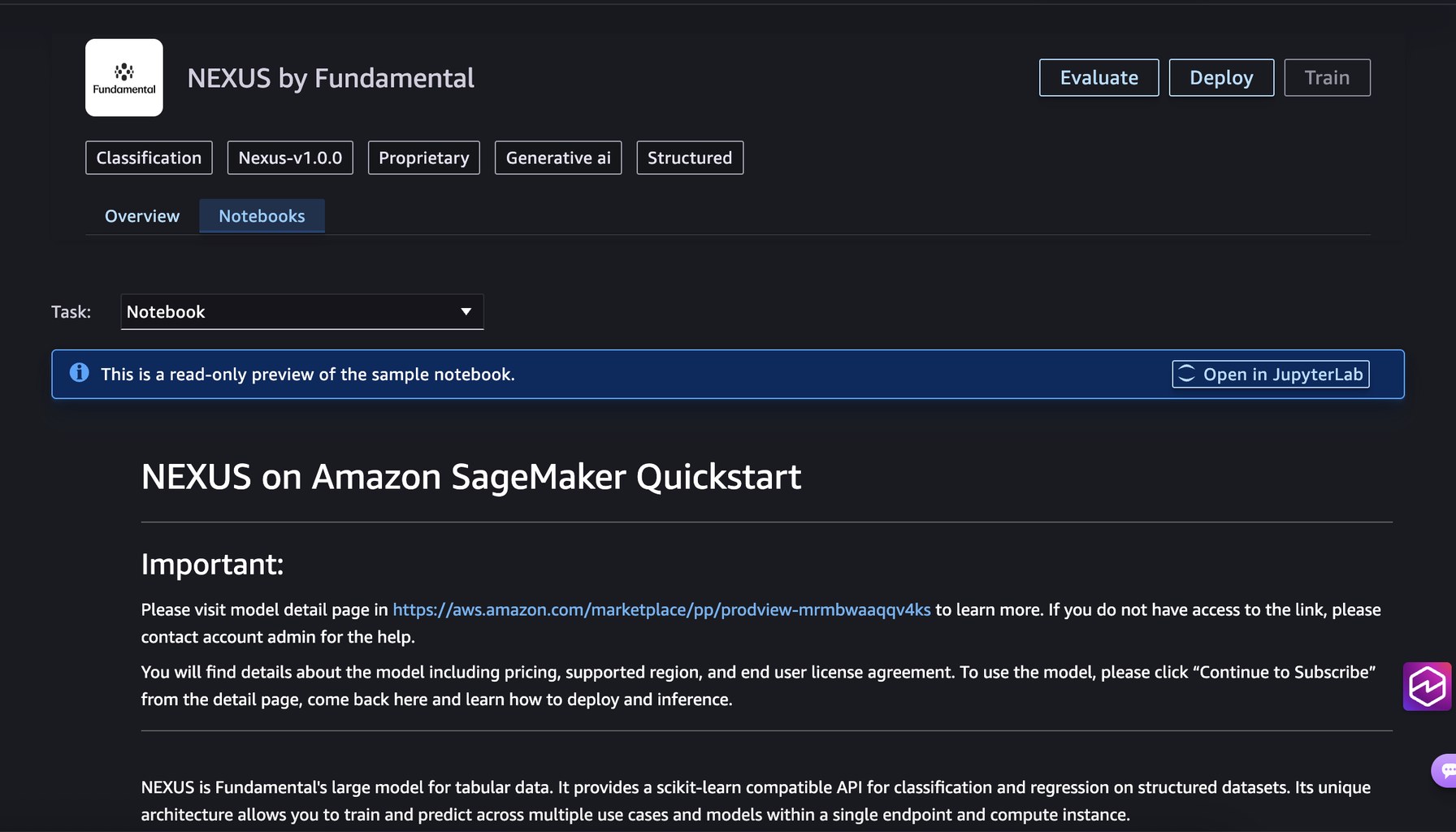
Fundamental’s NEXUS is now available on Amazon SageMaker JumpStart. The team reports a foundation model purpose-built for tabular data prediction that is pre-trained on billions of real-world prediction tasks, so it arrives ready to signal in enterprise datasets. NEXUS is described as a large tabular model that processes numbers, categories, dates, and unstructured text without heavy feature engineering, and it offers a deterministic architecture so outputs stay consistent for identical inputs. The model is positioned to tackle business questions that hinge on multi-factor interactions, for example churn, where factors like transaction frequency, support tickets, and broader economic indicators jointly shape attrition risk. For customers, that translates into faster deployment and repeatable results across diverse data environments, a shift AWS frames as moving from months to days of setup and evaluation.
The paper shows NEXUS’s core strengths in practice: native tabular understanding enables direct ingestion of structured data without pipeline gymnastics, and non-sequential reasoning lets the model consider multi-dimensional relationships across an enterprise table rather than limiting itself to sequential patterns. In the JumpStart deployment flow, enterprises can connect their datasets, run predictions, and observe deterministic outputs that reporters say minimize inconsistencies across runs. This is a meaningful step for teams wrestling with the long tail of structured data, where traditional feature engineering can be time consuming and brittle as schemas change or data interoperability challenges arise.
From an engineering perspective, the move is notable for lowering the barrier to a practical, production-oriented foundation model for tabular data. JumpStart is designed to streamline onboarding, governance, and security workflows, allowing data teams to test, validate, and scale predictions from core business tables without building bespoke data platforms from scratch. The upshot is not just a better predictive model, but a repeatable path to enterprise-ready inference that can plug into existing data pipelines and decision workflows. In industry terms, NEXUS reads as a disciplined counterpoint to text-centric LLMs: a model that thrives on numbers and structured signals while preserving the determinism that enterprises need for audits and compliance.
In another move that underscores SageMaker AI’s maturation as a tooling platform, a separate AWS post details how to improve an agent’s tool-calling accuracy using Supervised Fine-Tuning and Direct Preference Optimization. The guidance shows how to tune a small language model with curated, task-focused data and human preferences to improve tool selection, parameter formatting, and workflow chaining. The combination of SFT and DPO, illustrated via SageMaker AI training jobs, points to a growing pattern in which model quality is coupled with deliberate tooling and evaluation loops to reduce error-prone tool usage in production automation. Benchmarks indicate that these fine-tuning methods can meaningfully improve tool-calling accuracy, a critical piece as organizations push agents from pilot projects into reliable, end-to-end workflows.
Two practical takeaways emerge for practitioners watching this space. First, the deterministic, non-sequential reasoning approach of NEXUS matters for governance and reproducibility; in environments where every prediction must be traceable and consistent, this design reduces output variance and simplifies auditing across datasets and decision criteria. Second, the JumpStart deployment path lowers the time-to-value for tabular AI by removing friction in data integration and environment setup, but teams should still plan for data governance, schema alignment, and ongoing monitoring to maintain performance over evolving datasets. A third note for teams pursuing automation is to watch the SFT and DPO approach closely: it signals a maturing tooling layer that can tighten the feedback loop between real user needs and model behavior, but it also introduces data-labeling and preference-collection costs that must be managed.
If you’re planning a practical rollout, key questions to monitor include data quality and schema stability in your tabular datasets, how to measure determinism and reproducibility across inference runs, and how your governance and security controls map to JumpStart deployments. The broader takeaway is clear: AWS is stitching together stronger structured-data foundations with better, testable automation tooling. The result could be faster, more reliable enterprise AI programs where structured data and agent-enabled workflows move in lockstep rather than in separate silos.
- Fundamental’s Large Tabular Model NEXUS is now available on Amazon SageMaker JumpStartAWS Machine Learning / Primary source / Published JUN 03, 2026 / Accessed JUN 03, 2026
- Improve your agent’s tool-calling accuracy with SFT and DPO on Amazon SageMaker AIAWS Machine Learning / Primary source / Published JUN 03, 2026 / Accessed JUN 03, 2026