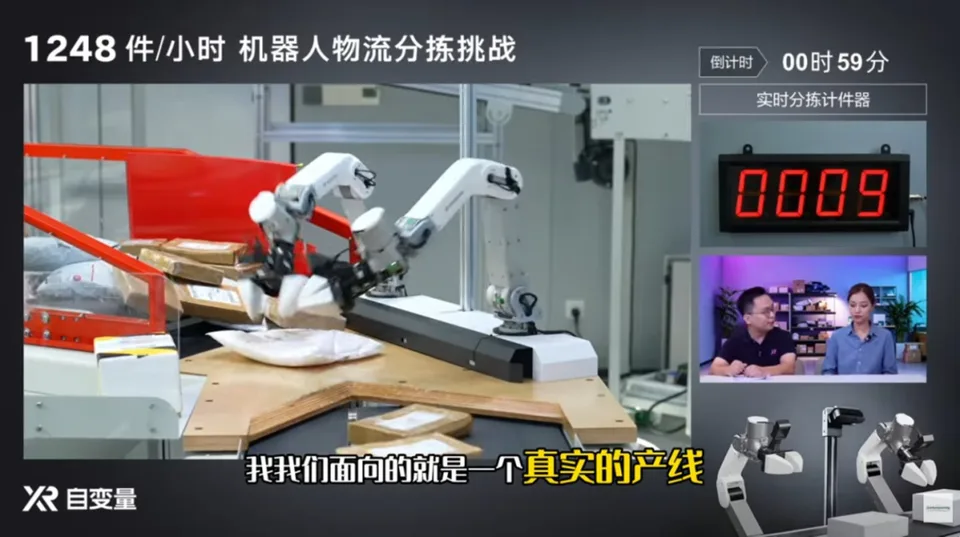
A Shenzhen sorting demonstration looks stronger than the company’s household pilot, which remains an early data-collection effort.
X Variable Robotics is testing whether one artificial-intelligence model can control robots across workplaces and homes. In Shenzhen, it demonstrated package sorting and partnered with 58 Group on robot-assisted home cleaning.
During an approximately one-hour livestream on Aug. 12, a dual-arm robot sorted random packages without human intervention, according to TMTPost. The company reported throughput of 1,816 items per hour and accuracy above 98%.
That result shows focused factory automation, not general household ability. TMTPost described package sorting as a relatively structured task, where items follow familiar handling patterns and the robot mainly identifies, grasps and turns them. The report also said comparisons with Figure AI were not directly comparable because the companies used different robots and testing periods.
The household test
In March, X Variable and 58 Group launched robot home-cleaning services in Shenzhen. The robot cleared tables, picked up trash, cleaned cat litter and helped fold quilts, while a cleaner handled deep cleaning in kitchens and bathrooms.
One blogger who ordered the service for 149 yuan reported that the robot took 10 minutes to fold one item of clothing. Over three hours, it organized a shoe cabinet, dining table and sofa while operating slowly and noisily, TMTPost reported.
X Variable also offered participating households subsidies of up to 3,000 yuan per month, capped at 6,000 yuan per household, for data collection. That points to an R&D pilot using real homes to gather training data, rather than a proven autonomous consumer service. The report does not establish whether the service remains available or how consistently it performs across homes.
X Variable describes its strategy as an end-to-end model linking what a robot sees, understands and does. It released WALL-A in 2024 and WALL-B in April 2026, presenting them as steps toward a “world unified model.”
The practical test is whether new homes require less fresh data, human help and site-specific adjustment over time.