A Color-Shifting Robot Finger Can Map Shape, Strain, and Pressure in Real Time
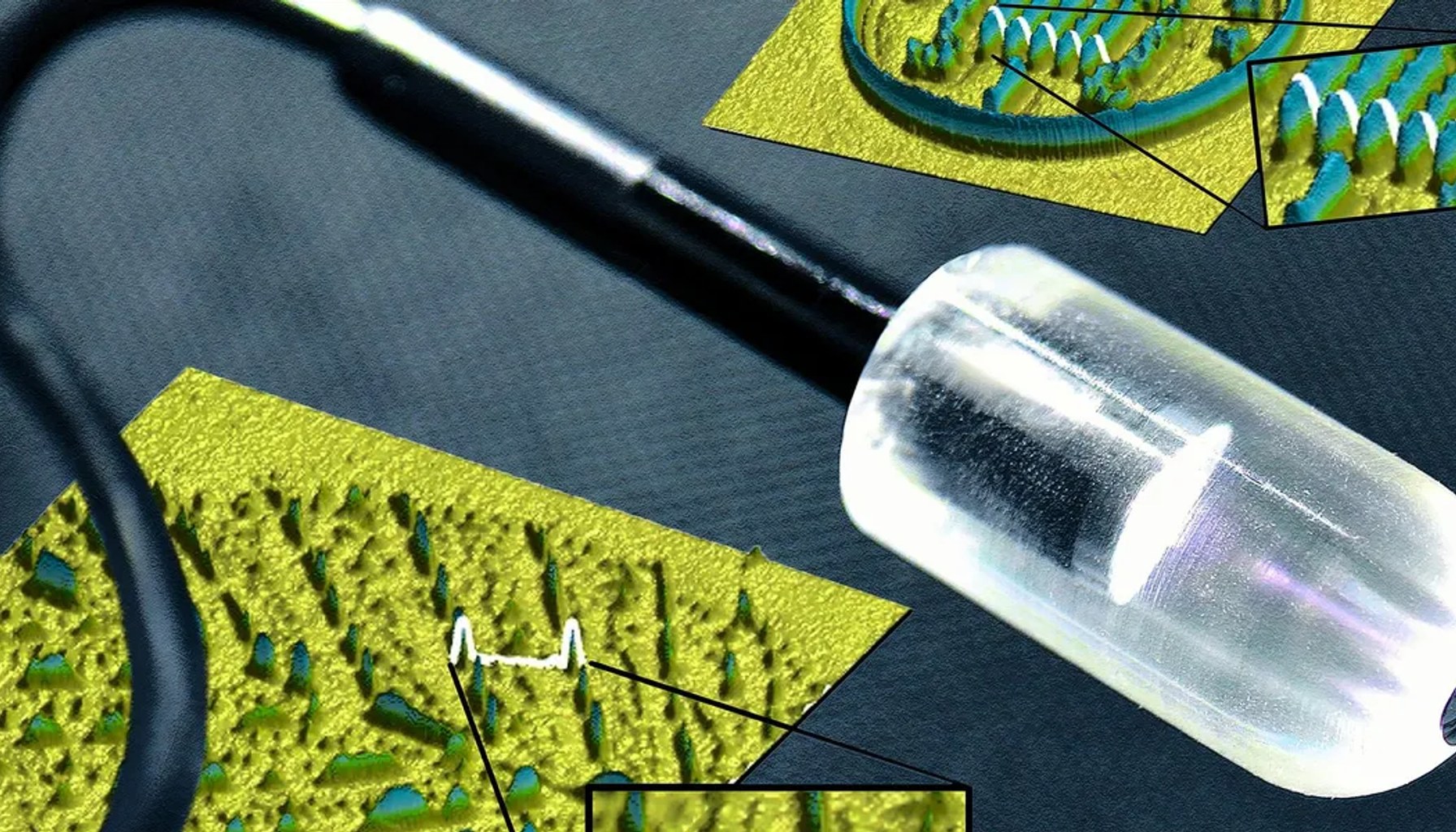
Image / spectrum.ieee.org
Researchers in Europe have shown a fingertip sensor that turns mechanical deformation into color, giving a robot hand finer tactile maps without the usual latency of pressure arrays.
What the sensor is doing
A team from Queen Mary University of London, the University of Florence, the University of Trieste, and the University of Trento has built a robotic fingertip that reads touch through a mechanochromic skin. Instead of relying on a dense grid of force sensors, the fingertip uses a synthetic material whose reflected color changes as it is deformed by contact.
That change in color is not just visual flair. According to the research team, the reflected wavelengths can be used to generate maps of topology, strain, and contact pressure in real time. In testing, the system produced maps of a human fingertip, a penny, and a leaf.
For engineers, the important part is the architecture: the sensing element is embedded in the fingertip material itself rather than layered onto the surface as separate taxels, or pressure-sensing pixels. That matters because robotic fingertips are cramped, and packing multiple sensor types into a small volume is often the bottleneck.
How the Bragg reflector works
The sensor’s core is a Bragg reflector made from a light-sensitive film. Giacomo Sasso, a postdoctoral research associate in the lab of Federico Carpi at Queen Mary University of London, adapted the material after coming across prior work in Nature on mechanochromic materials.
To create the reflector, Sasso exposed the film to a 5-megawatt, 635-nanometer red laser for seven minutes. The laser produces an interference pattern that polymerizes the film into alternating densities, creating layers with different refractive indices. That layered structure reflects specific wavelengths of light.
When the reflector is pressed or stretched, those layers deform, changing thickness and shifting the reflected wavelength. In the fingertip prototype, the color response runs from red at low deformation to green and then blue as deformation increases.
That makes the sensor more than a simple “contact present” switch. The color pattern itself carries quantitative information about the object’s surface geometry and the amount of local strain.
What the fingertip hardware looks like
The Bragg reflector is sandwiched between two silicone layers. An outer silicone layer protects the reflector, and the fingertip itself is a transparent silicone shell shaped like a finger, with a camera and LED embedded inside.
The LED sends light through the clear polymer. When an object presses on the fingertip, the reflector bounces light back to the camera, and the camera reads the reflected wavelengths associated with the local deformation.
The team also made practical adjustments to improve performance. The outer silicone layer is colored black to raise contrast, helping the camera distinguish color differences more clearly. The camera’s own rigidity helps deform the reflector more strongly, which increases the differences in reflected wavelengths and makes the signal easier to read.
After that optimization, the researchers reported 100-micrometer resolution with no computational latency. For a tactile sensor, that combination is notable: high spatial detail, and no software delay between contact and readout.
Why robotic hands still struggle with touch
Human skin does a lot with a little. It senses pressure, texture, vibration, and temperature, then feeds that information into motor control fast enough to manipulate objects. Robots can mimic pieces of that stack, but squeezing all of it into a fingertip-sized package remains hard.
As Rich Walker, director of Shadow Robot in the U.K., put it, choosing the right sensing modality is still unresolved. Shadow Robot, which focuses primarily on robotic hands, was impressed enough by the work to call it a distinctly different approach.
Walker’s point reflects the deployment reality: there is no single best tactile sensor for all hands, tasks, and budgets. Some sensors give contact location well; others are better at force, slip, or texture. The problem is not just detecting touch, but deciding what kind of touch data matters for manipulation.
Carpi’s team is interesting because it adds another option to that trade space. Its fingertip is not trying to imitate every aspect of human touch. It is targeting high-resolution surface mapping and deformation sensing in a form factor that fits a robotic finger.
Lab demo versus deployment
This is a strong lab result, not a fielded product. The system has demonstrated real-time mapping on objects such as a penny and a leaf, and it achieved fine spatial resolution in testing. That is meaningful proof of principle.
But deployment is a separate engineering problem. The evidence does not show a production-ready robotic hand, long-term durability data, factory calibration workflows, or evidence that the sensor survives repeated use outside controlled conditions. It also does not show how the fingertip scales across full hands, how it holds up under abrasion, or how it performs when dirty, wet, or exposed to variable lighting and contamination.
That distinction matters for operators and investors. A sensor can be elegant in the lab and still face integration issues in a deployed hand: packaging, replacement cost, calibration drift, cable routing, maintenance, and how easily the camera-and-LED stack can be integrated into a mass-manufacturable finger.
Still, the design has a practical appeal. By embedding tactile sensing into the material itself, the approach sidesteps one of robotics’ recurring constraints: not enough room for enough sensors. If the material can be manufactured consistently and ruggedized, it could become useful for hands that need fine surface discrimination rather than only gross grip force.
What this means for humanoid hands
Humanoid hands are engineering systems, not magic props. Their usefulness depends on payload, sensing bandwidth, control latency, and whether the hand can actually survive real work. A humanoid can have excellent locomotion and still fail at manipulation if its fingertips cannot tell the difference between a flat object, an edge, and a fragile surface.
This fingertip sensor addresses one of the hardest parts of the stack: giving a robot hand richer tactile data in a compact package. That may not solve grasping by itself, but it can improve the sensory input that manipulation software depends on.
For robotics teams, the takeaway is not that touch has been “solved.” It is that tactile sensing still has room for smarter materials, and that color-based readout from mechanochromic skin may be a useful path where traditional taxel arrays run out of space.
For operators and investors, the practical question is whether the sensor can move from a polished laboratory finger to a durable component in a deployed hand. The research says it can see well. The next question is whether it can work long enough, cheaply enough, and robustly enough to matter outside the lab.
- Mechanochromic Skin Gives Robot Finger Fine Sensesspectrum.ieee.org / Research / Published JUL 28, 2026 / Accessed JUL 30, 2026