Adobe Marketing Agent Boosts Amazon Quick Campaigns
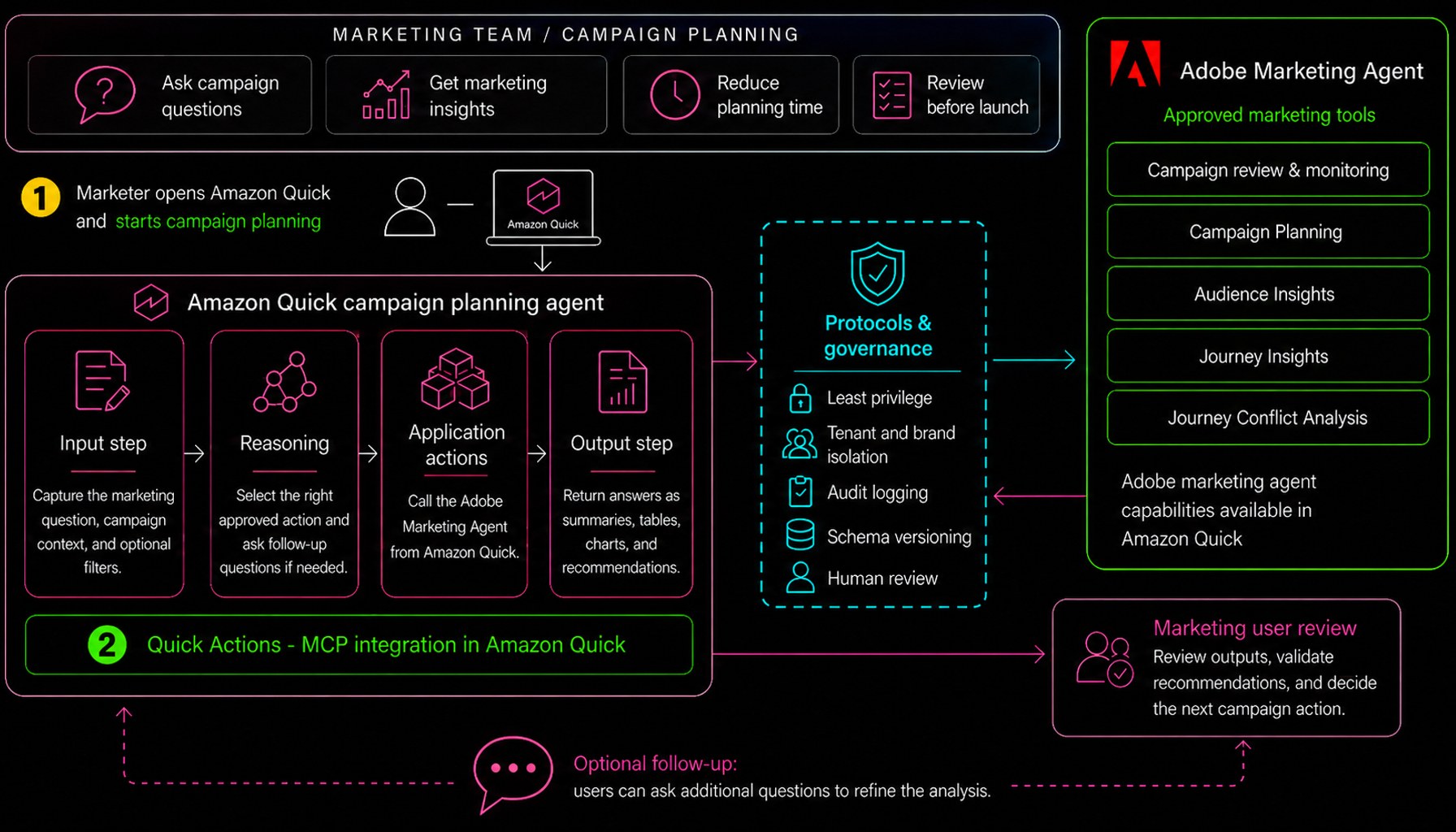
Image / AWS Machine Learning
Campaign insights arrive in seconds, not hours.
Marketing teams can now ask for campaign health in natural language and get actionable outputs in moments, thanks to a new integration between Amazon Quick and Adobe Marketing Agent. The collaboration uses the Model Context Protocol to connect Amazon Quick’s chat interface with Adobe’s marketing analytics tools, enabling conversations that surface audience rankings, loyalty summaries, journey usage, conflict recommendations, and content performance without manual data pulls. The team reports that the sample workflow returns these outputs within a governed conversation, with governance controls like least privilege and tenant isolation built in to keep data access tight.
In practice, the integration works as a live data handshake between two platforms. A marketer posing a campaign planning question in Amazon Quick triggers the Adobe Marketing Agent from an approved action set. The MCP server validates the request, then queries authorized Adobe marketing data behind the scenes. Amazon Quick renders the result as an answer, a table, a chart, or a recommendation. The architecture is designed to be end to end: external tools are discovered, registered as actions, and invoked mid conversation as needed. This setup is what allows a question about performance to be answered with concrete, role appropriate insights rather than an endless Excel drilldown.
The key outputs researchers tested include audience rankings, loyalty segment summaries, journey usage, conflict recommendations, and content performance summaries. The paper shows that marketers can surface these dimensions in a single conversational thread, rather than toggling between dashboards and reports. This is a meaningful shift for marketing operations, because it folds domain analysis into everyday chat rather than forcing analysts to assemble ad hoc reports from disparate data sources. By centralizing these insights in Amazon Quick, teams can preserve context and reduce the friction of multi tool workflows.
From a practitioner standpoint, two constraints stand out. First, governance and data access must be designed up front. The flow emphasizes least privilege and tenant isolation, which means teams need clear ownership of which Adobe data sources are exposed to Quick and who can authorize tool calls. Second, the performance of the workflow hinges on the responsiveness of external tools. Since the assistant calls out to Adobe’s services and then renders results, latency or outages in the MCP layer can ripple into the conversational experience. The upside, however, is a tighter feedback loop: questions that used to require separate analytics sprints can now be answered in the context of a live campaign conversation, shortening iteration cycles and aligning teams.
For marketing organizations, the integration represents a practical engineering constraint: you must curate approved actions and ensure sound governance, then rely on the MCP protocol to orchestrate cross system calls without leaking sensitive data. It also reveals a future path where more marketing domain tools can plug into a single conversational surface, enabling faster scenario planning and more consistent decision making. The team notes that the sample workflow exposes a structured set of tools, including audience ranking, loyalty analysis, journey lookup, conflict analysis, and content performance summaries, that can be extended as required, suggesting a scalable model for AI assisted campaign planning without sacrificing control.
Looking ahead, observers should watch how this pattern evolves as more external marketing services are added and as governance models mature to handle increasingly complex data domains. If the trajectory holds, AI driven marketing conversations could become the default entry point for planning, testing, and optimizing campaigns, rather than a privileged analytics layer tucked behind dashboards.
- Accelerate campaign workflow with insights from Adobe Marketing Agent for Amazon QuickAWS Machine Learning / Primary / Published JUN 19, 2026 / Accessed JUN 21, 2026