Armless robot learns fall recovery via force guided learning
An armless bipedal-wheeled robot can rise after a fall, thanks to a force-guided training trick.
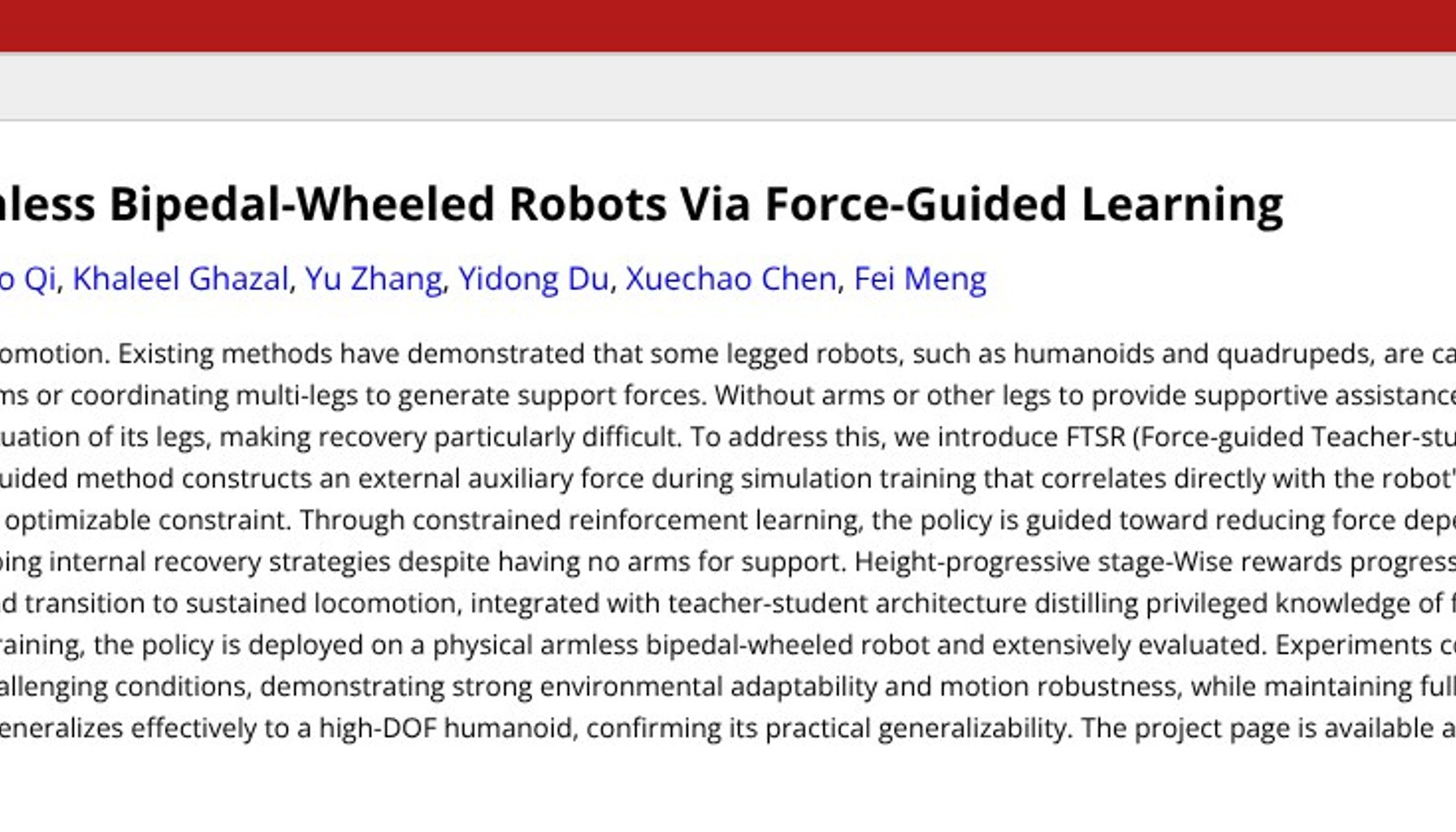
Fall recovery has long been a litmus test for legged robots. When a robot lacks arms or other limbs to brace a tumble, it must rely only on leg actuation to stand again. A new study introduces FTSR, a force-guided teacher-student framework with Stage-wise Rewards, to train armless machines to recover robustly in both simulation and on real hardware. The approach reframes recovery as a controllable learning problem, where the policy learns to use its own height signal to trigger and guide corrective motions without external contact.
The core idea is to inject an external auxiliary force during simulation that correlates directly with the robot’s real-time height. This force is not a fixed kick but an optimizable constraint that shapes how the policy behaves during a fall and during the initial lift back to upright. Through constrained reinforcement learning, the policy is guided to reduce reliance on the artificial force over time and to increase the body height, effectively developing internal strategies for recovery even though the robot has no arms to push against. Height-progressive stage-wise rewards explicitly structure the recovery sequence, first stabilizing posture, then transitioning to sustained locomotion once the robot stands. The teacher-student component distills privileged knowledge about force effects and recovery dynamics, helping the learned policy transfer from the simulator to a real machine more reliably.
Documentation indicates the policy was first honed in simulation and then deployed on a physical armless bipedal-wheeled robot for extensive testing. The results, described as robust and reliable under diverse conditions, point to strong environmental adaptability and motion robustness, with the robot maintaining full post-recovery motion capability. The authors also report that the framework generalizes effectively to higher degree-of-freedom humanoids, suggesting the approach could extend beyond the specific armless form studied.
For practitioners, the engineering take is clear: removing dependence on arm contact for recovery is not a matter of brute force, but of training discipline that ties posture to height and uses staged objectives to guide a policy toward self-contained recovery. The force-guided paradigm helps bridge the long-standing sim-to-real gap by embedding an explicit, learnable constraint and distilling how force interacts with recovery dynamics into a form a real robot can replicate. A project page provides additional detail on the force-guided approach and how the teacher-student loop is implemented, offering practical pointers for teams looking to reproduce or extend the work: https://2350575870.github.io/force-guided.github.io/.
Several concrete practitioner insights emerge from the work. First, the key feasibility leap is shifting fall recovery away from arm contact to height-driven control, enabling armless platforms to recover using only leg actuation. Second, sim-to-real transfer is strengthened by distilling privileged force-effect knowledge into the deployed policy, reducing the risk that the real robot behaves unpredictably when confronted with disturbances not perfectly captured in simulation. Third, the approach hinges on sensing and actuation fidelity: accurate height estimation and fast, safe generation of leg motions are critical to avoid overcorrecting or colliding with the ground during the recovery sequence. Fourth, deployment considerations include computational demands for reinforcement learning inference and the need to respect motor torque and heat limits during intense recovery maneuvers. Looking ahead, researchers will want to test across more terrains, scale to additional DOFs, and quantify energy cost and control-bandwidth requirements for real-time operation in production-like settings.
In short, the study reframes a stubborn robotics problem as a learning control challenge tied to the robot’s height, and it shows that an armless robot can reliably stand up again after a fall with the right training regime. The implications reach beyond a single chassis, signaling a practical path for broader classes of legged machines that must recover without multi-contact support.
- Robust Fall Recovery for Armless Bipedal-Wheeled Robots Via Force-Guided LearningarXiv Humanoid Robot Query / Primary source / Published JUN 12, 2026 / Accessed JUN 15, 2026