Balloon dog demo tests humanlike touch in robotics
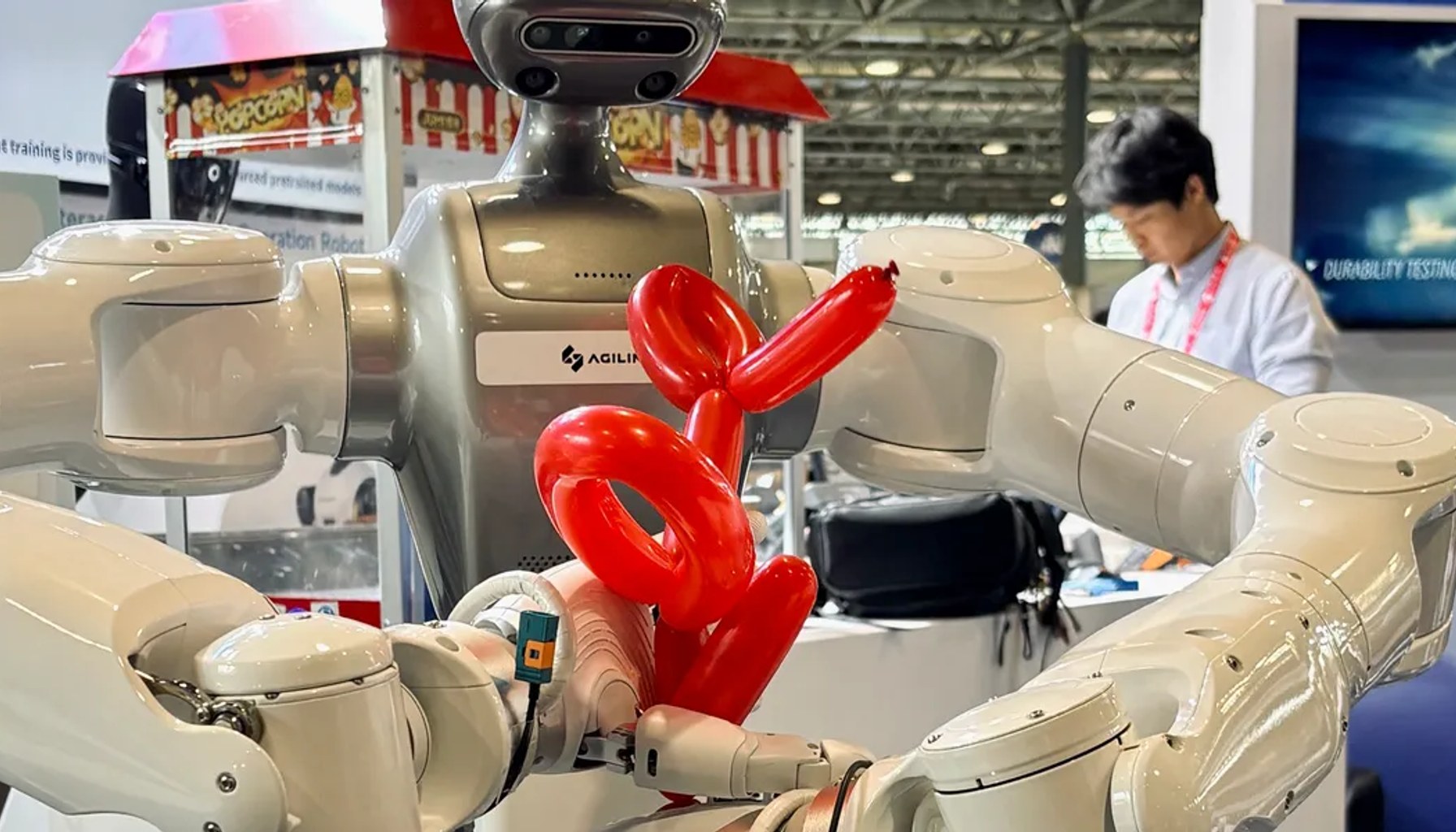
A balloon dog twist by AGILINK's OmniHand proves contact is the new frontier.
At the 2026 IEEE International Conference on Robotics in Vienna, AGILINK drew crowds with a balloon animal that grew and twisted under the careful, almost patient control of two robotic hands. The setup looked playful, but it was a deliberate demonstration of a much harder problem: manipulating a highly deformable, slippery, and pressure-sensitive object without letting it slip, pop, or collapse. Humans do this with little conscious thought; robots, until now, have struggled when the object itself keeps changing shape as you touch it. The company calls its approach the OmniHand platform, and the demonstrations included visuotactile sensing, in-hand manipulation, balloon-animal shaping, and other contact rich tasks. AGILINK’s display underscored a broader shift in robotics from precise spatial motion to intelligent contact management.
Testing shows that the real bottleneck is not simply getting fingers to the right places, but maintaining stable interaction as the object morphs. The balloon dog becomes a moving target in the hands, forcing the system to respond to tiny shifts in geometry and internal pressure in real time. The demo didn’t reveal numeric specs such as degrees of freedom or payload, and the company has not published those figures for this particular run. What was clear is that the OmniHand platform couples tactile sensing with sight to close the loop around contact, a pairing that helps the robot decide when to grip, how hard to push, and where to slip-resistantly adjust.
From a practitioners’ view, the ICRA display offers two actionable takeaways. First, contact intelligence is now a design constraint, not an afterthought. The balloon demonstrates that keeping contact stable in the face of changing shape requires fast, texture-aware feedback and control that can interpret tactile signals alongside visual data. That combination makes manipulation possible, but it also highlights latency and processing demands. Second, the task sits in a lab environment at a technology conference, not in a factory floor. The demonstration shows what is feasible under careful calibration and constant supervision, but deployment at scale will demand robust calibration routines, fault handling for sensor dropouts, and limits on task variability.
A broader lesson for robotics teams is that success in contact-rich manipulation hinges on the full stack, not a single sensor or a clever motion plan. Visuotactile sensing provides a richer picture of the contact state, but it must be integrated with control policies that can absorb noise, misalignment, and the unpredictable consequences of deformable objects. In practice, that means engineers will need to tune grip strategies, slip resistance, and force regulation together with perception in near real time. It also means that product timelines will be bound to how well these systems scale from a controlled balloon experiment to real world tasks that include diverse materials, textures, and fragility.
For now, the balloon dog demo crystallizes a simple, stubborn truth about dexterous robots: the future belongs to systems that see and feel their way through contact, not just move through space. The ICRA show signals a production horizon where touch is not a nicety but a core capability, enabling delicate handling, in-hand manipulation, and novel manipulation tasks that were previously out of reach.
- Beyond Dexterity: Why Contact May Define the Next Era of RoboticsIEEE Spectrum Robotics / Independent source / Published JUN 09, 2026 / Accessed JUN 15, 2026