Humanoid robots perform gallbladder removal in lab trial
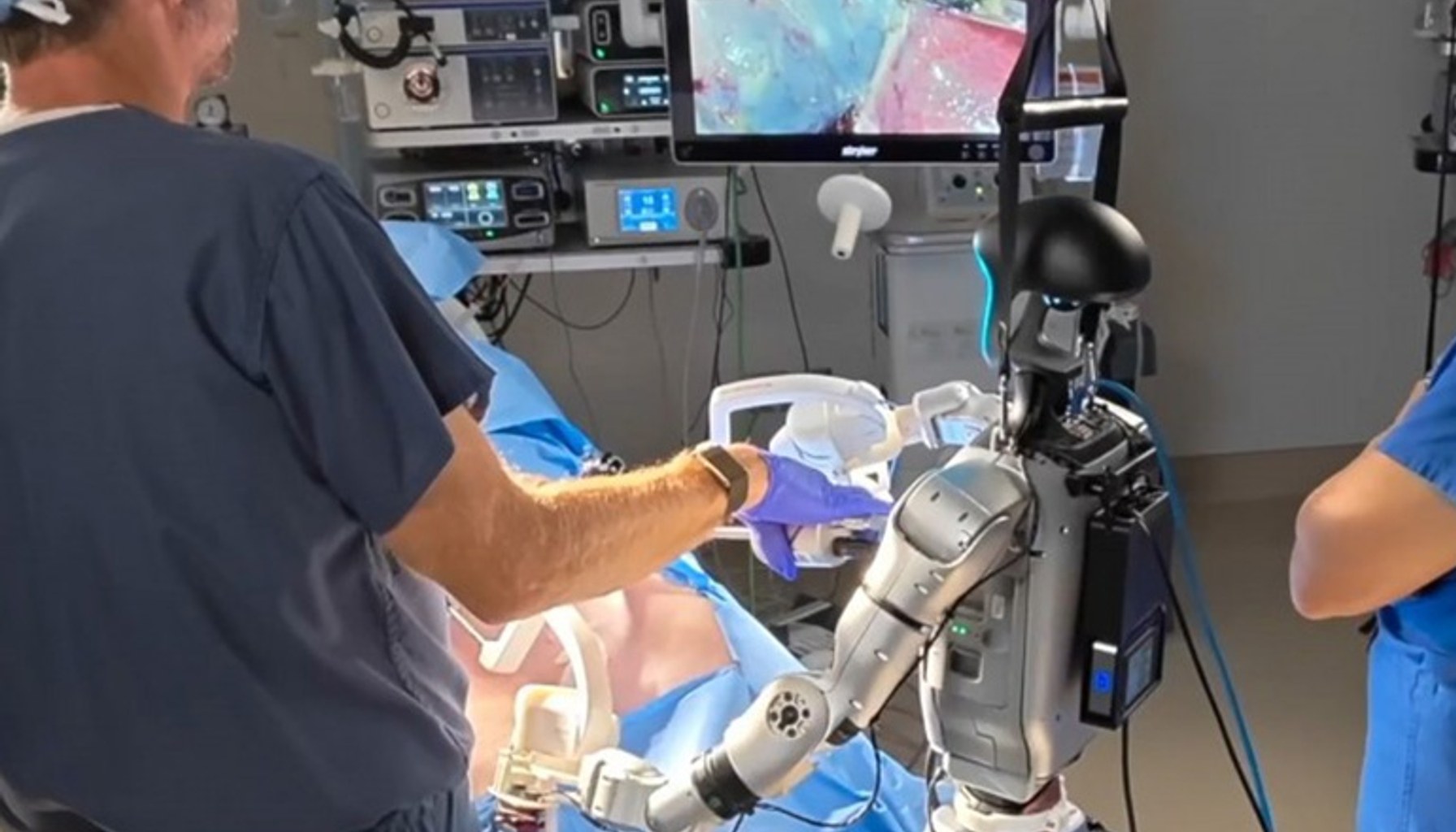
Image / The Robot Report
Two teleoperated humanoid robots just performed a gallbladder removal.
In a lab-based preclinical trial, researchers at the University of California San Diego used two teleoperated humanoid robots to complete surgeries on large non-primate mammals, reporting their findings in Nature. In the first procedure, a humanoid robot operated under the guidance of a human surgeon acting as an assistant, demonstrating how a humanoid platform could share control with a clinician in real time. In the second, two humanoids worked side by side in a robot-to-robot collaboration to carry out the same task. The effort is framed as a proof-of-concept step toward introducing humanoids into the operating room, with the long-term arc of enabling remote, or autonomous, performance of a broader set of procedures.
The team, led by UC San Diego researchers including Michael Yip, a professor in electrical and computer engineering, argues that humanoid robots offer versatility beyond the fixed, procedure-specific platforms that dominate today. “Remotely operated and autonomous humanoid robots have real potential for amplifying access to critical surgeries to which patients would otherwise not have access,” Yip said, underscoring the practical drive behind the work. Unlike established systems such as Intuitive Surgical’s da Vinci or Stryker’s Mako, which are tailored to particular tasks, the researchers pursue a more general-purpose platform that could, in principle, handle a wide range of operations and general tasks in the OR.
The experiment is intentionally early and controlled. By performing the gallbladder removal on non-primate mammals, the team tests core capabilities (precise manipulation, robust teleoperation, and the robot’s ability to integrate with a surgeon’s workflow) without crossing into clinical human subjects. The split into two configurations (one human-guided and one robot-guided) helps illuminate how far the technology has to go before widespread adoption. The study positions humanoids as a potential bridge between current teleoperation, where a clinician pushes and guides a remote machine, and autonomy, where the robot would carry out steps without direct on-site control.
From a robotics perspective, the work translates to a broader engineering lesson: surgical robotics is less about hero devices and more about reliable system integration. The first key takeaway is that a humanoid platform must balance dexterity with reliability. The second is that any viable path to the OR will hinge on safe, latencylimited, and sterilizable interfaces that can withstand the OR’s demanding schedule. In practice, these systems must negotiate the same constraints that plague any medical robot today (latency budgets, force feedback, sterility of end-effectors, instrument exchange, and cleanroom-compatible power and maintenance cycles) while adding the complexity of a generalist hardware skeleton that can host many instruments and procedures.
There are clear tradeoffs to watch. A versatile humanoid promise can reduce the number of robot types a hospital must invest in, potentially lowering long-term capital costs and expanding clinical flexibility. But it also compounds engineering challenges: more joints, more sensing modalities, and a broader set of failure modes. The move from teleoperation with a human in the loop to a collaborative robot team or to autonomous action will require rigorous safety cases, fail-operational behaviors, and regulatory pathways that can handle a broader treatment repertoire.
What to watch next, in practical terms, includes how the team expands beyond proof-of-concept demonstrations to more extensive trials, how latency and haptic feedback are improved, and how sterile workflows are maintained as the platform scales. Observers will also want to see how surgeons adapt to working with a humanoid’s form factor and how the system integrates with OR teams, scheduling, and sterilization cycles. If the trajectory holds, humanoid robots could move from niche demonstrations to the early stages of pilots that test collaboration with clinicians, before broader regulatory and clinical adoption.
- Beyond da Vinci: Why versatile humanoid robots are the next frontier in surgeryThe Robot Report / Trade / Published JUL 09, 2026 / Accessed JUL 10, 2026