One chat agent handles all meeting prep and followups
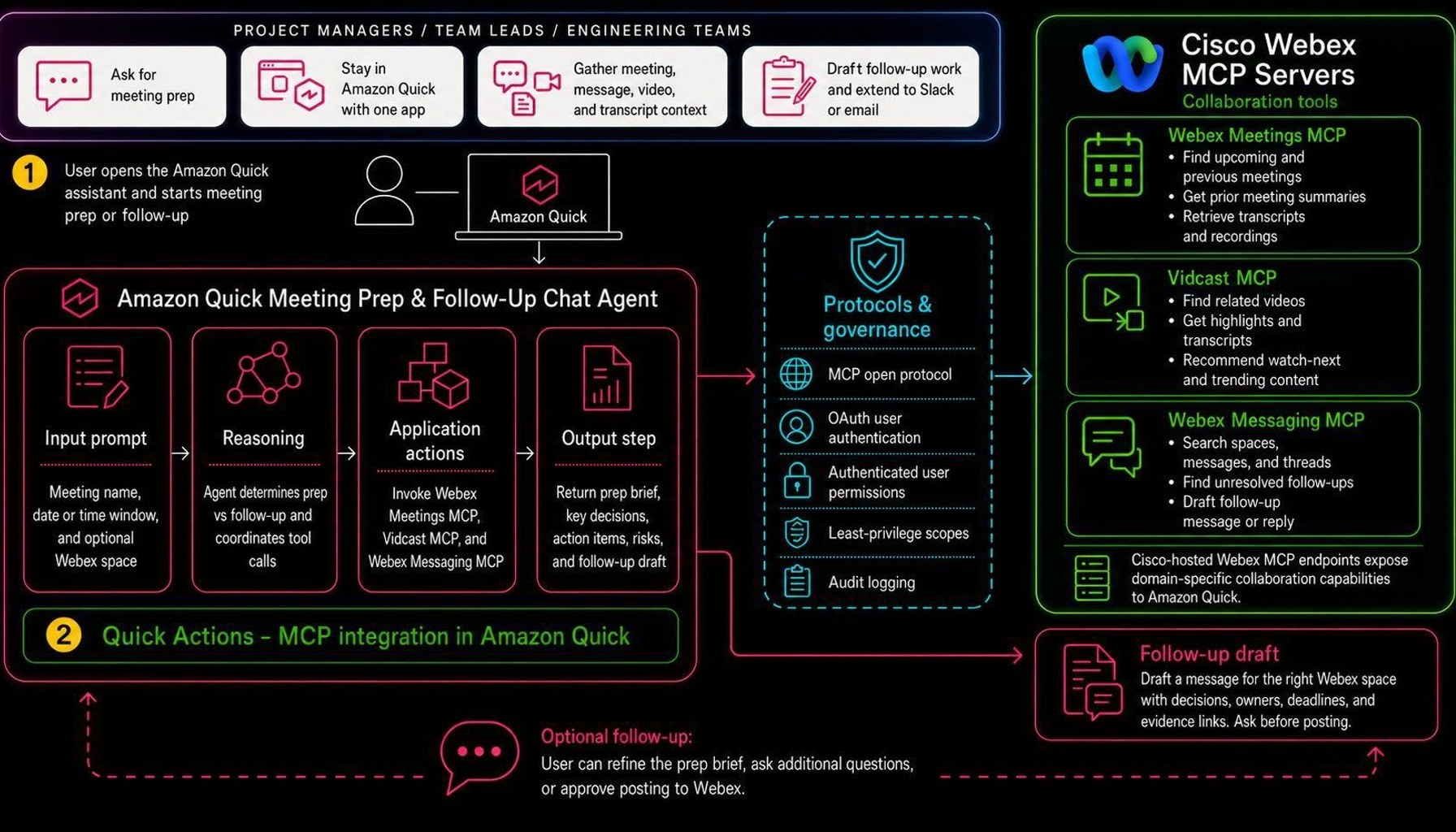
A single chat agent preps meetings and drafts action items. The integration of Amazon Quick with Cisco Webex MCP servers lets teams keep Webex meetings, Vidcast clips, transcripts, and message threads in one conversational flow. From a single prompt, the agent identifies the next Webex meeting, reviews prior summaries, and pulls relevant Vidcast highlights and transcript context. It then searches Webex message threads for unresolved followups and creates a concise prep brief. After the meeting, the same agent can summarize the discussion, flag action items, and draft a follow up in the right Webex space.
For project managers, team leads, and engineering squads, the value is tangible: less time hunting through transcripts, recordings, and chat threads, and less switching between tools. The assistant stays in the single Amazon Quick workspace while the context is retrieved through Cisco MCP servers, and it can also pull in content from enterprise sources such as Amazon S3, Google Drive, Microsoft SharePoint, Atlassian Confluence, or internal web pages. The same conversational agent can use more than 100 pre built action connectors to perform tasks in Slack, Microsoft Outlook, Atlassian Jira, ServiceNow, and Salesforce. The business outcome is straightforward: teams gain continuity from one recurring meeting to the next, with a consistent prep brief, a cleaner post meeting summary, and a ready to send follow up that lands in the right space.
The architecture is deliberate about breadth and speed. By weaving together Webex context, Vidcast highlights, and message threads, the tool reduces the cognitive load on team members who otherwise stitch together notes from multiple sources. The enterprise data layer from S3 to SharePoint and Confluence provides a backbone for reference material, while 100 plus connectors push actions into collaboration and workflow systems. In practice, leadership teams glimpse a shift from fragmented workflows to a unified conversational workspace that turns meeting history into actionable, recoverable context for the next cycle.
As this kind of workflow scales, observers are quick to remind builders that evaluation matters just as much as features. When an agent autonomously selects tools and sequences operations, a surface check on the final answer can miss subtleties such as data provenance, tool outputs, or whether a step was properly verified. The field is moving toward infrastructure that traces every tool call, data return, and intermediate state. The team reports that systematic evaluation is essential to catching below the surface failures, and that tools like Agent-EvalKit can help. Agent-EvalKit provides ground truth test cases and instrumentation to capture tool usage within development environments, integrating with AI coding assistants and producing reports with concrete improvement guidance that reference exact locations in code. The paper shows that faithful end to end evaluation helps teams distinguish real capability from surface polish, a distinction that matters once agents orchestrate dozens of sources across an enterprise stack.
First, data governance matters. With input flowing from S3, Drive, SharePoint, and Confluence, access controls and audit trails are non negotiable. Second, reliability grows as connectors multiply. The team must design for latency, timeouts, and graceful degradation when one of many connectors falters. Third, verification is mandatory. Beyond correctness of the final summary, teams must ensure data provenance and tool usage are faithfully reflected in the output, hence the value of empirical evaluation infrastructure. Fourth, success is measurable. Time saved per meeting, consistency of action items, and reduction in manual context switching become the north star for adoption and ROI.
In short, this rollout points to a practical path for enterprise AI: bundle multi source context into a single conversational workspace, implement robust tool orchestration, and back the confidence with rigorous, tool level evaluation.
- Build a meeting prep and follow-up assistant with Amazon Quick and Cisco Webex MCP serversAWS Machine Learning / Primary source / Published JUN 12, 2026 / Accessed JUN 12, 2026
- Evaluate AI agents systematically with Agent-EvalKitAWS Machine Learning / Primary source / Published JUN 11, 2026 / Accessed JUN 12, 2026