Güdel expands grinding reach with vertical and horizontal motion
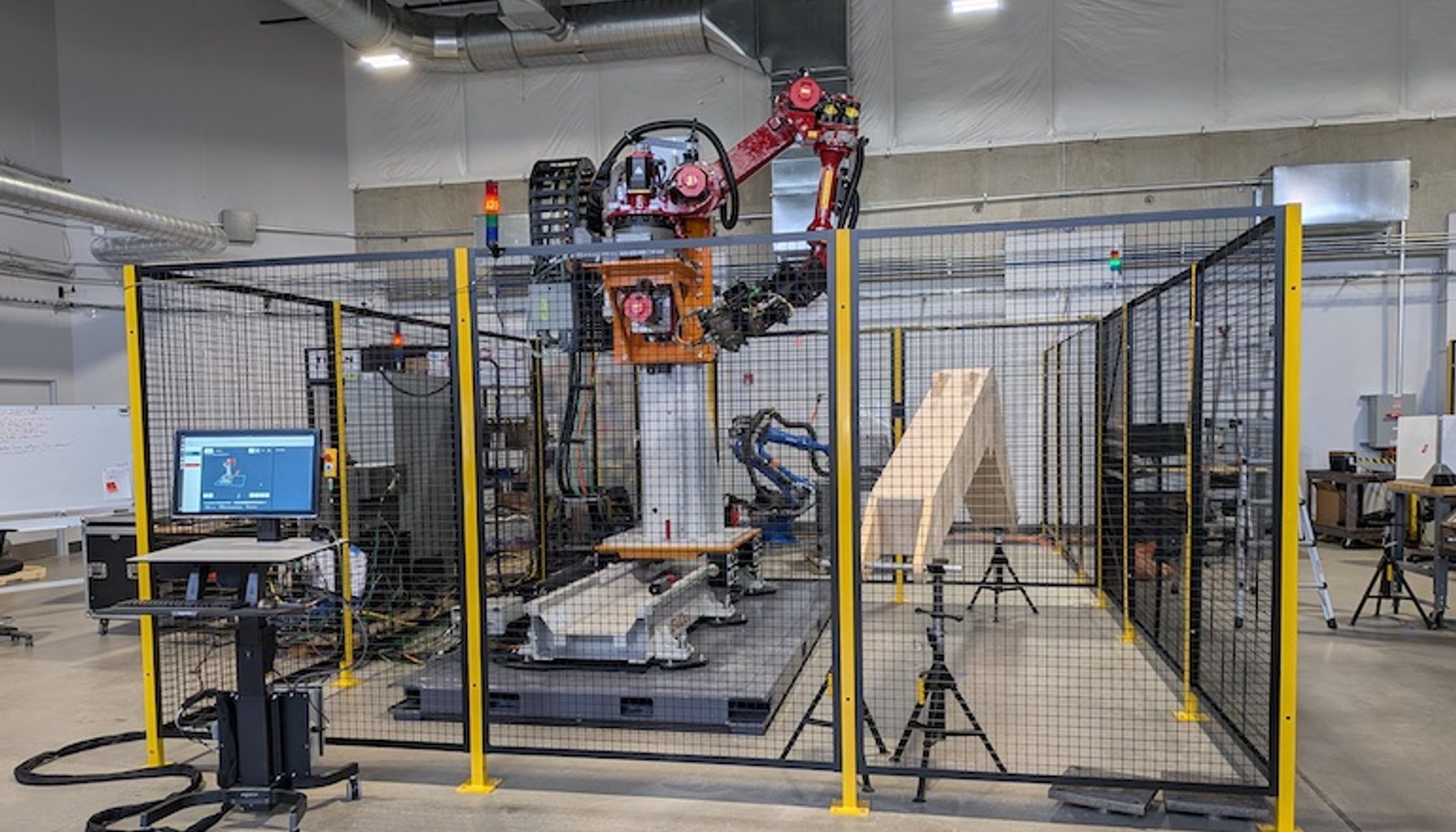
Image / The Robot Report
One robot now covers a giant work envelope, slashing upfront costs.
Grinding and surface finishing of fabricated parts has long punished automation with complexity and cost. Traditional setups often rely on stationary robots paired with repositioning fixtures or multiple robotic cells to reach awkward geometries, driving capital, programming, and safety costs higher and cycle times longer. Güdel AG aims to flip that script at Automate 2026, where it will showcase a grinding system that moves a robot not just in place but across a wider workspace with integrated vertical and horizontal motion. The company argues that expanding the robot’s reach is the decisive lever that makes automation feasible for large, difficult to reach parts.
The core idea is simple in concept but meaningful in practice: a single robot, guided by a multi-axis motion system, can service an entire large envelope, reducing or even eliminating the need for several fixed units and the part handling gymnastics that previously came with them. Güdel emphasizes three strategic advantages:
From a practical standpoint, the technology promises more predictable cycle times and throughput gains by cutting or eliminating the discrete repositioning steps that plague traditional grinding lines. In theory, a longer, continuous approach to grinding a part, with one coordinated motion path rather than a sequence of repositionings, translates into fewer pauses and faster part completion. But the real world impact will hinge on how well the multi-axis system integrates with existing controllers, safeguards, and programming tools, and how effectively it can be tuned for specific part families.
For plant managers and operations leaders, several careful considerations come into play. Integration requirements are nontrivial: the new system must talk to the plant’s control architecture, synchronize with other robots or machines on the line, and conform to safety standards for a larger, more mobile robot footprint. Off-line programming and virtual commissioning will be important, as will robust path planning to maintain accuracy across a broader working area. The broader reach also introduces new failure modes to watch: vibration and deflection over long, dynamic paths, wear in the extended motion axes, and the need for reliable collision detection when the tool and part travel through expansive envelopes. Training and change management matter too, because operators and technicians must understand a more complex motion plan and the new way of thinking about cycle optimization.
There is a candid caveat every practitioner should keep in mind. The promise of plug and play automation remains aspirational; even ambitious multi-axis solutions require engineering, alignment, and debugging. The extraction of real ROI depends on disciplined planning, rigorous integration, and careful monitoring of how cycle time, part quality, and maintenance costs evolve after deployment. As Güdel positions its demonstration at Automate 2026, the industry will be watching not just the ability to reach large parts, but the degree to which the system actually reduces the total cost of ownership while delivering stable, repeatable grinding performance at scale.
As the automation conversation shifts toward scalable reach and fewer cells, Güdel’s approach adds a tangible option for shops grappling with long, complex parts. If the data from Automate 2026 backs up the promised stability and integrated reach, the path to replacing clusters of fixed grinders with a single, more capable motion-enabled robot could begin to reshape linelike grinding strategies across automotive, aerospace, and heavy industry suppliers.
- Güdel to show grinding beyond stationary robots with vertical, horizontal motion at Automate 2026The Robot Report / Trade / Published JUN 21, 2026 / Accessed JUN 22, 2026